
Utilities can quietly punch your budget in the face. And a lot of renters don’t notice until month two, when the “affordable” place starts eating your grocery money.
When we work with renters at Rental Secrets, utility costs are one of the fastest ways to spot whether a listing is truly a deal or just priced to look like one. Tours are where you can get real answers. Not perfect. But real enough to plan.
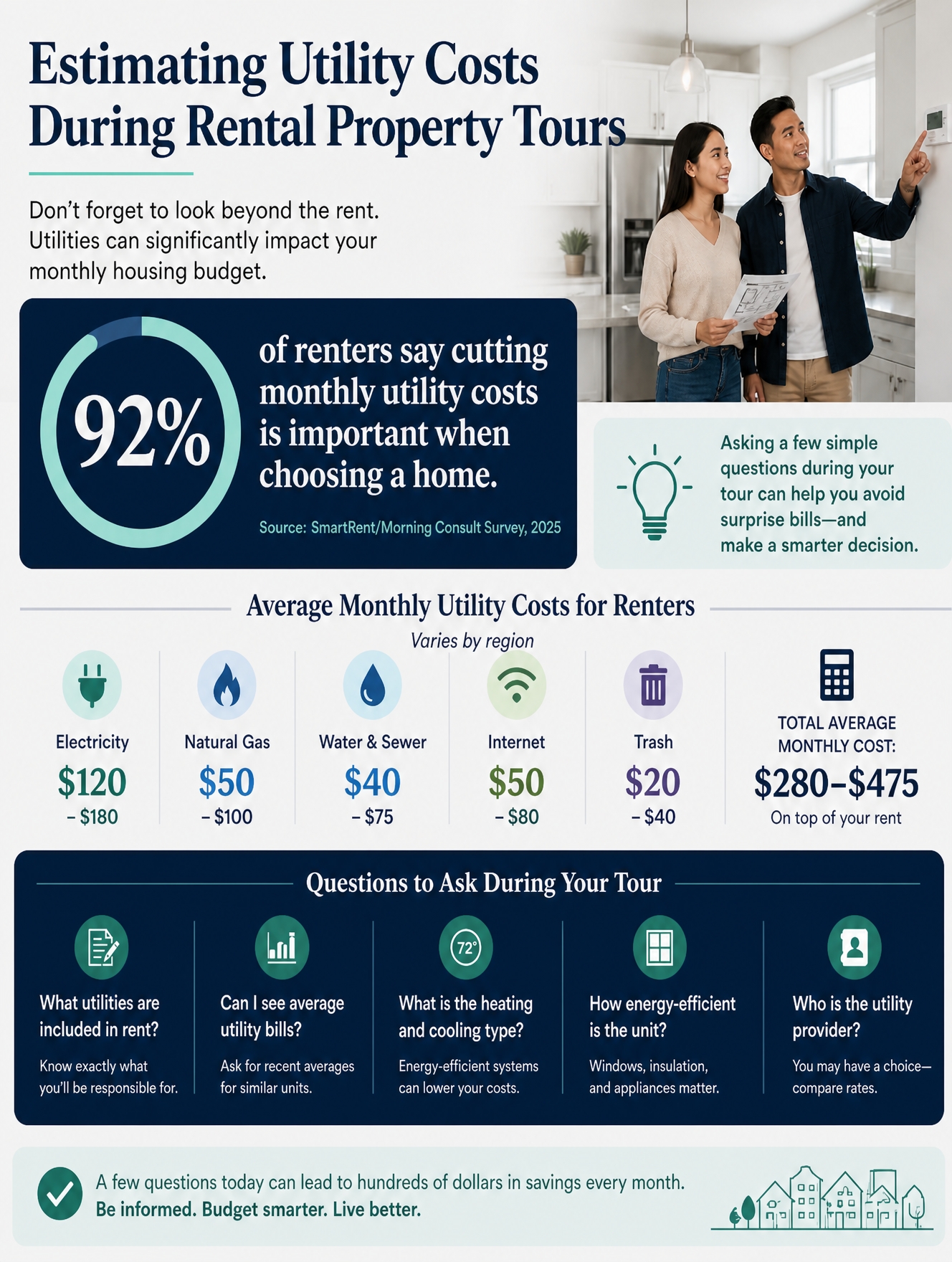
Start with who pays for what and get it in writing
Look, listings love to say “tenant pays utilities” like that’s one single thing. It’s not. It’s five things. Sometimes eight.
Ask the boring question early
Right after the hello. Before you start admiring the countertops.
Try: “Can you walk me through exactly what utilities I’d pay here, and what you cover?”
And then. One more: “Is it separately metered?” That phrase matters. Separately metered usually means you’re paying for your unit only. Not your unit plus the hallway lights plus the laundry room with the dryers that run forever because nobody cleans the lint traps.
Watch for shared meters and flat fees
Shared metering is where budgets go to die. It can be legal. It can work. It can also be a mess. A “ratio utility billing system” might show up (RUBS). That’s where they split the building’s bill using occupancy, square footage, or some formula. Sounds fair. However, it often feels… not fair.
Ask: “Do you use RUBS or any allocation formula for water, sewer, trash, or gas?”
If they stumble. That tells you something.
And if there’s a flat utility fee, get the exact amount and what it includes. Flat fees can be awesome. Or a trap. Depends on the number and whether it changes seasonally.
While you’re thinking through the bigger cost picture, our cost perspective tips for property tours can help you spot the other sneaky line items people forget to ask about.

Do a quick “heat and hot water” reality check
Heat is usually the biggest swing. Not always. But most of the time, that’s the one doing the real work here.
Figure out the heat type in 30 seconds
On tour, you can usually identify it without being weird.
- Baseboard electric: long heaters along the wall. Can be pricey in cold climates.
- Gas furnace: vents in floor or ceiling, thermostat runs it. Often cheaper than electric.
- Boiler and radiators: cast iron radiators or baseboard hot water. Sometimes included in rent.
- Heat pump: outdoor unit plus indoor air handler. Efficient, but climate matters.
- Mini-splits: wall-mounted units. Can be great. Also depends on how many zones you’re paying to run.
If you see a little wall unit and no ducts, ask what it is. Don’t guess.
Hot water: the underrated bill
I used to ignore hot water. Turns out hot water is a stealthy budget vampire, especially in older buildings with tired water heaters.
Ask: “Is hot water gas or electric? And is it a tank or tankless?”
Then ask where the water heater is. If it’s in your unit and looks ancient, that’s a clue. If it’s central for the building, find out whether it’s included or billed back to you through RUBS.

And a weird one that works: ask how long it takes to get hot water at the farthest faucet. If they say, “Oh yeah, it takes a bit,” that “bit” is literally money going down the drain.
Read the unit like a utility auditor
This is the part where you stop touring like a shopper and start touring like a person who likes keeping their paycheck.
Windows, drafts, and the “hand test”
Put your hand near window edges. Seriously. You’ll feel it if the place leaks air. And if it’s a windy day? Even better.
Double-pane windows tend to behave. Old single-pane windows tend to make the heat run nonstop. Storm windows help. Sometimes. Sometimes they’re just there to make you feel better.
Appliances and lighting: small stuff that adds up
Check the fridge age. Old fridges can be power-hungry. Ask if it’s ENERGY STAR. If the property manager doesn’t know, that’s fine. You can still look for the label.
Peek at the water fixtures too. If the showerhead looks like a fire hose, your water and hot water costs will show it. Low-flow fixtures aren’t glamorous, but your bill will notice.
And laundry. In-unit laundry is convenient. It also shifts cost to you. Ask whether the machines are electric or gas, and whether the dryer venting is decent. A poorly vented dryer runs longer. Longer means more money.
When you want a full tour checklist that goes beyond utilities, we keep a bigger playbook in our rental property tours guide for budget-smart renters. We built it from the stuff renters actually run into. Not theory.
Get numbers without being awkward
Most renters ask “How much are utilities?” and accept whatever comes back. A vague “not too bad” is the classic non-answer.
Ask for ranges and seasonal highs
Try: “What do utilities tend to run in winter and in summer for a typical tenant?”
That wording helps. It’s normal. It gives them room to answer without promising a number.
And then: “What’s the highest bill you’ve heard of for this unit?”
People remember pain. They’ll often share the scary month even if they can’t recall the average.
Ask for proof that doesn’t feel like a demand
Here’s the line I use with clients when we’re coaching them: “Would you be able to share a recent utility bill for this unit, with personal info blocked out?”
Some landlords will do it. Some won’t. If they won’t, ask if they can at least share the building’s typical ranges.
You can also ask who the providers are. Then you can call and ask about average costs by address. Sometimes the utility company will share averages. Sometimes they won’t. Depends on the provider and privacy rules.
One more option that’s surprisingly effective: ask a neighbor in the hallway. Quick. Casual. “Hey, sorry to bug you. Do you mind if I ask what you usually pay for electric here?”
Worst case, they ignore you. Best case, you get the most honest number of the day.
Use utility estimates as negotiation ammo without overplaying it
Real talk: utilities aren’t always negotiable directly. Rent is. Fees are. Sometimes move-in credits are. That’s where your utility homework helps.
Translate risk into a specific ask
If you discover baseboard electric plus drafty windows, your takeaway isn’t “this place is bad.” Your takeaway is “this place costs more to live in than the rent suggests.”
So you ask for something concrete. Examples we’ve seen work:
Ask for a rent reduction that reflects the monthly utility premium. Or ask for a winter credit. Or ask for weatherstripping, window repairs, or a programmable thermostat installed before move-in. Small fixes can change the math.
I had a client last month who toured a cute older unit. Amazing light. Terrible windows. The landlord insisted the rent was firm. Fine. We didn’t argue. We asked for $600 off the first month to cover the first heating season spike, plus written confirmation that the landlord would re-caulk and add door sweeps. They agreed. Not because they’re saints. Because we made it easy to say yes.
Don’t get trapped by “utilities included” either
Utilities included can be a win. Or it can be baked into inflated rent. Ask which utilities are included. Ask whether there are caps. Ask whether internet is included or just “available.” That word “available” is doing a lot of work.
And if it’s included heat in a building with radiators, ask whether you control it. If you can’t control it, you might save money. You might also live in a sauna with the windows cracked in January. That happens more than people admit.
FAQs for Estimating utility costs during rental property tours
What’s the fastest way to ballpark utilities during a tour?
Ask what’s separately metered, ask for winter and summer ranges, and identify the heat type. That combo gets you 80 percent of the picture. Then sanity-check with a neighbor or the utility provider if you can.
Should I avoid electric heat completely?
Not automatically. Electric heat in a newer, tight, well-insulated place can be totally fine. Electric heat in a drafty older unit with big windows can get ugly fast. The building envelope matters as much as the fuel type. Sometimes more.
Your next step on tour
On your next tour, don’t hunt for one perfect number. Hunt for the story. Heat type. Metering. Drafts. Included versus billed back. Then turn that into a monthly range you can live with.
And if the story feels fuzzy, that’s your answer too. Push for clarity. Or price the uncertainty into your negotiation. That’s the whole thing.
Disclaimer: This article does not constitute legal advice.