

Ask about co-signer rules before you fall in love with the place. Seriously. Co-signer requirements can quietly decide whether you get approved, what you’ll pay upfront, and how awkward Thanksgiving gets if you ask your aunt to sign and then miss rent.
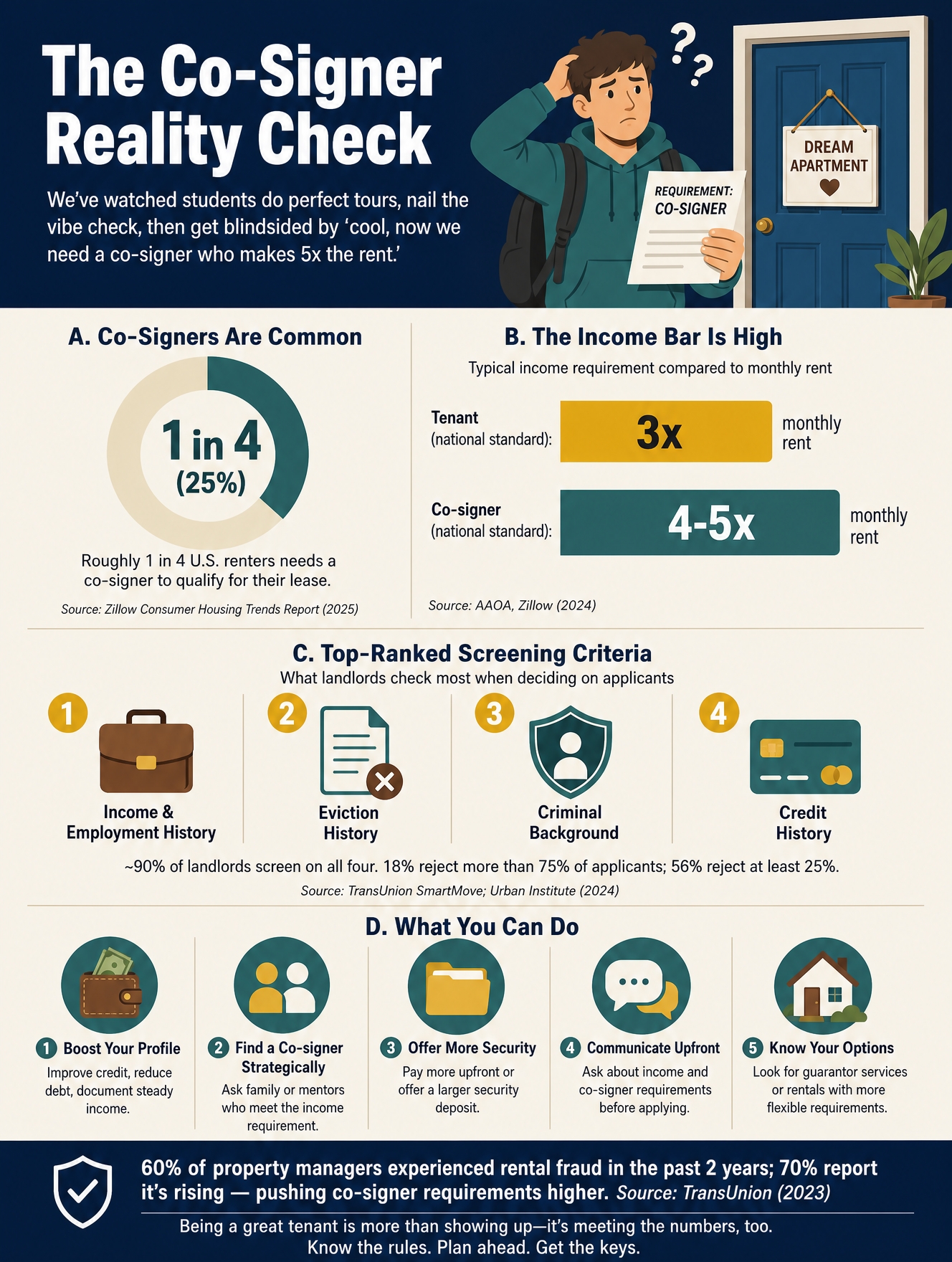
We’ve watched students do perfect tours, nail the vibe check, then get blindsided by “cool, now we need a co-signer who makes 5x the rent.” That’s not a small detail. That’s the door to your future home locking you out.
Co-signer basics landlords actually care about
Look, a co-signer isn’t a reference. It’s not a nice “character” thing. It’s a second financial backstop. The landlord is basically saying: “If you don’t pay, we’re going to them.”
And yes, most property managers have a policy. But policies flex more than people think. Especially if you show you’re low-risk in other ways (stable income, strong savings, clean rental history, solid guarantor).
Ask who can qualify as a co-signer
This sounds obvious. It isn’t. Some places only accept a parent or legal guardian. Some allow any relative. Some will take any adult with qualifying income and credit. And some will only accept a co-signer who lives in the same state. That last one bites international students a lot.
When I work with clients on this, the first thing I ask the leasing agent is, “Is your guarantor policy fixed, or can it be approved case-by-case?” The tone of the answer tells you everything.
Ask what the co-signer is really signing
Joint and several liability. That phrase matters. It usually means the co-signer is responsible for the full rent, not just “their share.” Even if you have roommates. Even if the roommate is the one who bailed. Even if the issue has nothing to do with the co-signer personally.
Ask: Is the guaranty limited to rent only, or does it include damages, fees, legal costs, and lease-break penalties? A lot of guaranty agreements sweep in everything. Late fees. Court costs. Cleaning charges. The stuff people argue about for months.

The questions to ask during a tour so you do not waste time
Thing is, tours are emotional. You picture your desk by the window. You smell the in-unit laundry, and your brain goes quiet. Then the application hits you like a brick.
So we recommend you bring co-signer questions into the tour conversation early. Not as a confession. Just as a normal part of screening.
Ask for the approval math and what triggers a guarantor
Ask what income multiple they require for you. Then ask what multiple they require for a co-signer. They might say “3x income for applicants, 5x for guarantors.” Or “applicant needs 2.5x, guarantor 4x.” Or they’ll mumble and say “it depends.” Push a little. In a friendly way.
Also ask what counts as income. Scholarship refunds? Financial aid? A job offer letter? Stipends? Some managers accept those. Some won’t. I’m not a fan of vague answers here. Vague answers usually become “no” later.

Ask what they do with roommates and split income
Here’s a sneaky one. Some properties require each roommate to qualify individually. Others let you combine income. And the co-signer piece changes too.
Ask: If we apply as a group, does one guarantor cover everyone or does each roommate need their own? I had a client last month who assumed one parent could co-sign for a four-bedroom. Nope. The building required four separate guarantors. The deal fell apart in 24 hours.
If you want a bigger playbook for what to ask and watch for during tours, our rental property tour checklist for budget-smart renters goes way beyond the pretty countertops. It’s the stuff that decides your monthly costs.
How to protect your co-signer and yourself
Real talk: asking someone to co-sign is asking them to take on risk. You want to be crystal clear about that. And you want to reduce the odds you ever need them.
Ask if the co-signer can be removed later
Some leases allow a “guarantor release” after 12 months of on-time payments, or once your income meets the requirements. Many don’t. It depends on the property’s rules and how much admin they’re willing to do.
Ask the exact process. Is it a new application? A credit check? A fee? A full lease renewal? If they say “we’ve never done that,” assume it’s a no. You can still ask for it. Just don’t bank on it.
Ask about lease term changes and automatic renewals
This bugs me because it’s where co-signers get trapped. A co-signer might think they’re backing one school-year lease. Then the lease auto-renews month-to-month. Or renews for another year unless you give 60 days’ notice. That guaranty might keep running.
Ask: Does the guaranty end on the original lease end date, or does it carry into renewals and extensions? Get the answer in writing. Email is fine. Screenshot it. You’d be shocked how often “that’s not what we meant” shows up later.
And talk with your co-signer about your own safety rails. A separate savings buffer. Auto-pay. Roommate rent collection rules. It’s not romantic. It’s rent.
Workarounds when you cannot get a co-signer
Not everyone has someone who can co-sign. Or someone they trust. Or someone they want involved. Totally valid.
Most of the time, you’re not doomed. You just need options that landlords recognize as reducing risk.
Ask about alternatives they will actually accept
Before you offer random ideas, ask what’s on their menu. Some properties accept:
- Higher security deposit where legal
- Prepaying last month’s rent, sometimes more (again, where legal)
- A larger upfront “risk fee” (we don’t love these, but they exist)
- Proof of savings or a bank statement above a threshold
- A guarantor service or institutional guaranty program
Quick caution: local laws vary a lot on deposits and prepaid rent. Some cities cap deposits. Some ban extra months upfront. So ask what’s allowed in that jurisdiction, not just what the property wishes it could do.
Use the co-signer conversation as a negotiation lever
Here’s the part people miss. Co-signer requirements are also a signal about how competitive the building is and how nervous the owner feels about vacancy.
If they’re strict but the unit has been sitting, you have room to negotiate. Not always on the guaranty rule itself. But maybe on move-in costs, fees, or even rent.
At Rental Secrets, we teach renters how landlords think. Timing, comps, vacancy pressure, internal quotas. The co-signer policy is one more window into that. A property manager who’s chasing leasing targets may be more willing to approve a student with strong documentation, even if the template policy says “no.”
If you’re renting with roommates or as a student and want more tactics like this, our rental tour tips for students and roommates page has more of the real-world stuff that changes outcomes.
FAQs for What students should ask about co-signer requirements
Can a co-signer be on the hook if my roommate does not pay?
Usually yes, if the lease is joint and several (most roommate leases are). That means the landlord can pursue any signer or guarantor for the full balance, not just “your portion.” Ask the leasing office how the lease is structured. Then read the guaranty agreement. The actual wording matters more than the verbal summary.
Will a co-signer have to pass the same credit and background checks as me?
Most of the time, yes on credit. Background checks vary. Some properties screen guarantors for prior evictions or housing-related judgments. Others only care about income and credit score. Ask what they run, what the minimums are, and whether a thin credit file is an automatic denial.
Next step before you apply
Get the co-signer policy in writing. Not later. Now. An email reply is enough.
Then compare it to your real situation, not your best-case version. And if the policy looks brutal, don’t waste application fees on hope. Tour another place. Or negotiate with a stronger packet. That’s the move.
Disclaimer: This article does not constitute legal advice.