

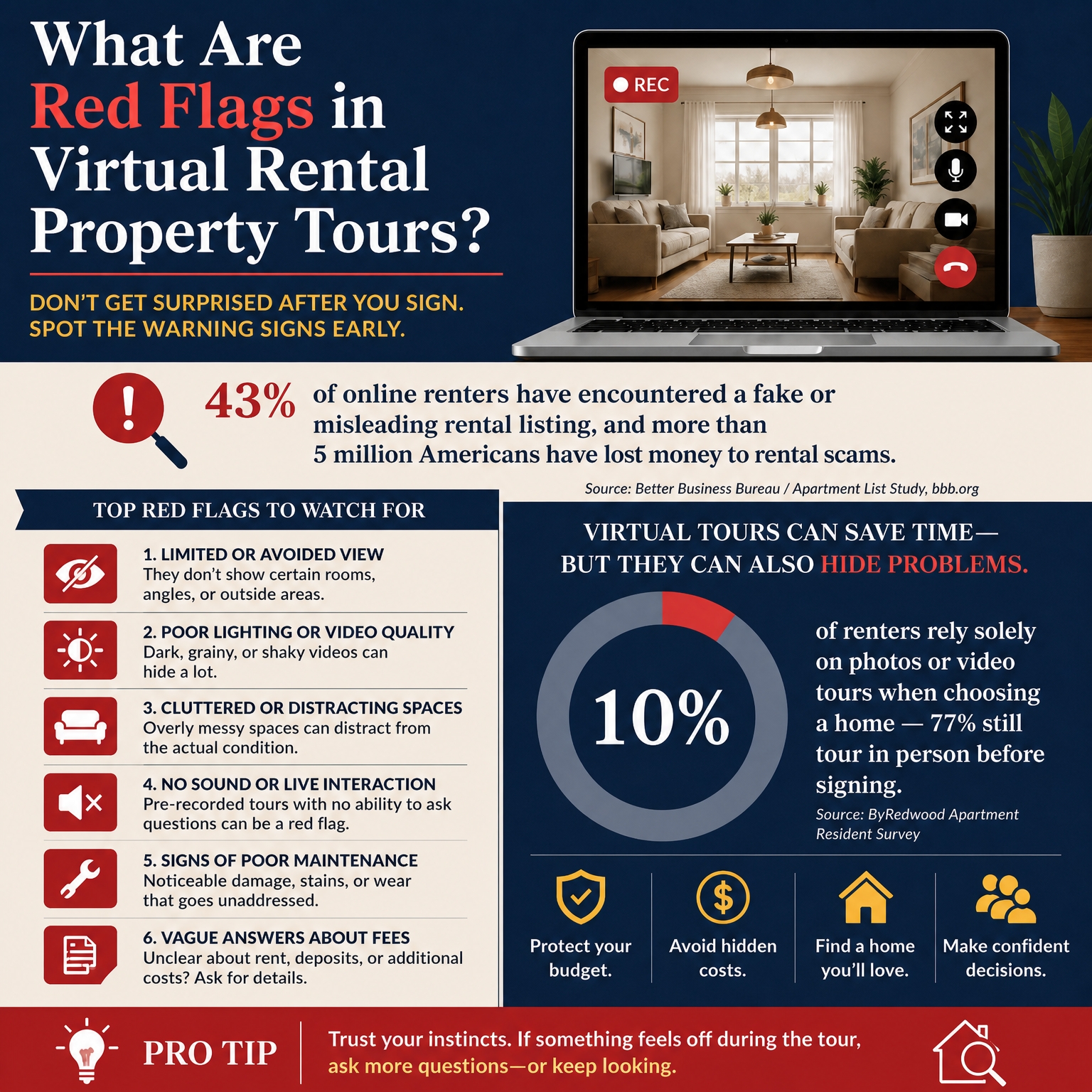
Red flags in a virtual rental tour usually show up fast. Like, in the first two minutes. You just need to know what you’re looking at. And what you’re not being shown.
We’ve walked a lot of renters through this at Rental Secrets. Students trying to keep loans down. Young professionals juggling rent and childcare. Families trying to stop moving every year. Same story. The scammy stuff isn’t always flashy. It’s often… weirdly normal. Too normal.
The video itself can tell you the truth
Look, a legit virtual tour doesn’t need Hollywood production. But it does need continuity. A real place feels connected. The scam tours feel like a collage.
Choppy footage and missing transitions
If the tour jumps from living room to bedroom with no hallway, that’s not “just editing.” That’s a missing link. Sometimes literally. We’ve had clients send us tours where the layout made zero sense, like the kitchen was somehow on two different sides of the unit.
And yeah, some landlords are just bad at filming. Happens. But a normal bad video still shows the flow of the space. You can tell where doors lead. You can track the light through windows. Continuity is hard to fake.
Overly tight shots that avoid context
This bugs me. The camera is pressed up against a wall. You see a faucet, not the sink. A corner of a room, not the room. That’s not “minimalist filming.” That’s hiding the fact that the vanity is cracked or the flooring is peeling or the windows are old single-pane rattlers.
Ask for a slow pan from each doorway. Doorway matters. It forces perspective. It’s hard to disguise a tiny bedroom when you’re filming from the door frame.
Pressure tactics are the loudest red flag
Honestly? Most virtual-tour scams aren’t fancy. They’re emotional. They push urgency. They try to get you to act before your brain catches up.
Rushing you toward money before basics
Any version of “send a deposit to hold it” before you’ve seen the lease, verified ownership, and confirmed showing access. Nope. Even if they call it a “holding fee.” Even if they promise it’s refundable. Plenty of scams use a tiny payment because it feels harmless. Then it’s another fee. Then another.
I had a client last month who got hit with the “application first, tour later” line. They were told they’d be sent the address after paying. That’s backwards. Application only comes after you know what you’re applying for.
They won’t answer normal renter questions
You know the questions. Utilities. Internet options. Parking. Pet policy. Lease term flexibility. Average monthly costs. If they dodge and pivot to “so when can you pay,” that’s not sales skill. It’s a tell.
And if you want a broader framework for how virtual tours should work when they’re legit, our main guide to virtual rental tours for budget-focused renters lays out what to ask for and how to compare units without getting played.
Identity and ownership gaps that don’t add up
Real talk: you’re not just renting a unit. You’re entering a contract with a person or a company. Virtual tours can make it easy for someone to pretend they’re that person.
They can’t prove they control the property
We recommend asking for one of these: a live video call where they show the unit and open the lockbox, a business email tied to a property management domain, or documentation that matches public records. Not all landlords have a fancy setup. Fine. But they should still be able to prove they’re the one who can hand you keys.
Watch for the classic mismatch stuff. The name on the email doesn’t match the name on the lease draft. The phone number changes. The “assistant” takes over. It starts to feel like a relay race.
Address weirdness and listing duplication
Here’s a small move that saves a lot of pain. Google the exact address. Then Google a sentence from the listing description. Scammers copy and paste. A lot. If you find the same photos on a different site with a different price or different contact info, stop. Just stop.
Also. Verify the unit number exists. Some scams use a real building address and invent an apartment number. You show up and the leasing office has never heard of it.
Condition red flags that hit your budget later
Some virtual-tour red flags aren’t scams. They’re “this place is going to eat your paycheck.” And that’s still a problem if you’re trying to keep your housing costs sane.
They avoid the stuff that reveals wear
Floors. Window frames. Baseboards. Under-sink cabinets. The ceiling around bathroom vents. These spots tell you how the unit’s been maintained. When someone refuses to show them, assume they look rough.
We’ve seen tours where the camera never once points down. That’s deliberate. Floors are expensive to replace. Landlords who are behind on maintenance know renters will notice right away.
Utility and noise clues they won’t talk about
Ask what heating type it is. Electric baseboard? That can spike winter bills. Old window AC units? Summer bills. Drafty windows? Both. And in a virtual tour, sound matters too. If the person filming keeps muting, talking over background noise, or avoiding windows facing the street, we get curious.
One exception. Sometimes they mute for privacy. Fair. But they should be willing to show you a 10-second clip standing by the window with no talking. Just ambient noise. That’s it.
- Refusal to show the electrical panel or confirm amperage when you ask about AC or laundry
- “Utilities included” with zero detail on caps, seasonality, or what’s actually included
- No shots of inside closets, under sinks, or around toilets
- Only one angle per room, always from the “best” corner
- No mention of laundry location, then vague answers when you ask
How we pressure-test a virtual tour before you apply
So, what do you do with all this without turning into a full-time detective? You use a simple verification routine. We use a version of this with clients because it keeps you grounded. And it protects your wallet.
Ask for one live proof moment
We recommend requesting a short live video walkthrough. Five minutes. Nothing fancy. Have them start outside at the building number. Then walk to the unit door. Then unlock it. That one sequence eliminates a big chunk of scams.
And if they say they’re out of town? Totally possible. Then ask who their local contact is and how that person is authorized. A legit manager usually has a vendor, a leasing agent, or a lockbox system. A scammer has excuses.
Use the lease as a lie detector
Ask for a blank copy of the lease before paying anything. Not “we’ll send it after approval.” A blank template. Read the fees section. Late fees. Move-in fees. Admin fees. Utility billing method. This is where cheap rent turns into not-so-cheap rent.
This is also where Rental Secrets helps renters negotiate like adults. The rent number is only one knob. Lease length, concessions, fee waivers, parking, and timing matter. A landlord might not drop monthly rent, but they’ll often budge on something that lowers your total cost to move in. That’s the kind of stuff we teach because it actually works.
If you want more scam-prevention tactics around remote showings, we keep a running set of resources in our virtual rental tour safety and scam prevention category. It’s the stuff people learn the hard way. We’d rather you not.
FAQs for What are red flags in virtual rental property tours
Is it ever normal to pay a holding fee before seeing the place in person?
Sometimes a legit property manager will take a holding fee after you’ve verified the unit exists, you’ve had a real tour, and you’ve received written terms that explain how the fee is applied or refunded. The red flag is paying anything when you don’t yet have proof they control access to the unit or you don’t have a real lease document to review.
What’s the safest way to verify a landlord during a virtual tour?
A short live video walk where they start at the building number and unlock the unit is the cleanest. Pair that with matching names across the lease, payment portal, and communication method. Most of the time, scammers can fake one piece. They struggle to fake all of it consistently.
Your next move before you fall in love with the listing
Here’s the thing. Virtual tours can save you time and money. They can also make it easier to get hustled because you’re not physically there. So we slow it down on purpose.
Ask for continuity. Ask for one live proof moment. Get the lease early. And if the vibe is urgency plus vagueness, trust that feeling. It’s usually right.
Disclaimer: This article does not constitute legal advice.