

Rental applications can feel like a pop quiz you didn’t study for. Especially when you’re a student, a first-time renter, or you’re just trying to keep your monthly budget from exploding. We get it. Our team at Rental Secrets spends a lot of time translating landlord logic into renter moves that actually work.
And yes, you can absolutely make yourself look “easy to approve” without pretending you’re someone you’re not. You just need to know what landlords screen for, what to prepare, and how to explain the stuff that looks weird on paper.
What landlords are really trying to figure out
Look, most landlords aren’t trying to judge your life choices. They’re trying to avoid a headache. They want to know two things: will you pay, and will you take care of the place.
When we work with renters on applications, the first thing we check is whether the application tells a clean story. Not a perfect story. Clean. No gaps that make someone nervous.
The three screens you run into most
Income and stability. Landlords are usually looking for steady income, not “high” income. Paystubs, offer letters, consistent deposits. That’s the vibe they’re looking for.
Credit history. Not just the score. Payment patterns. Collections. Evictions. And yes, student loans show up.
Rental history and behavior risk. Prior landlords, references, and anything that hints at late payments or damage.
Here’s a stat that should calm you down a little. About 45 million U.S. adults have no credit score or an unscorable credit record, according to the Consumer Financial Protection Bureau. So if you’re thinking “I’m the only one with thin credit,” you’re not. Landlords see this every week.

Students and first-time renters have different problems
Thing is, student applications fail for different reasons than, say, a mid-career renter. It’s not usually anything they’ve done wrong. It’s missing paperwork, thin credit, or an income that doesn’t look like traditional wages.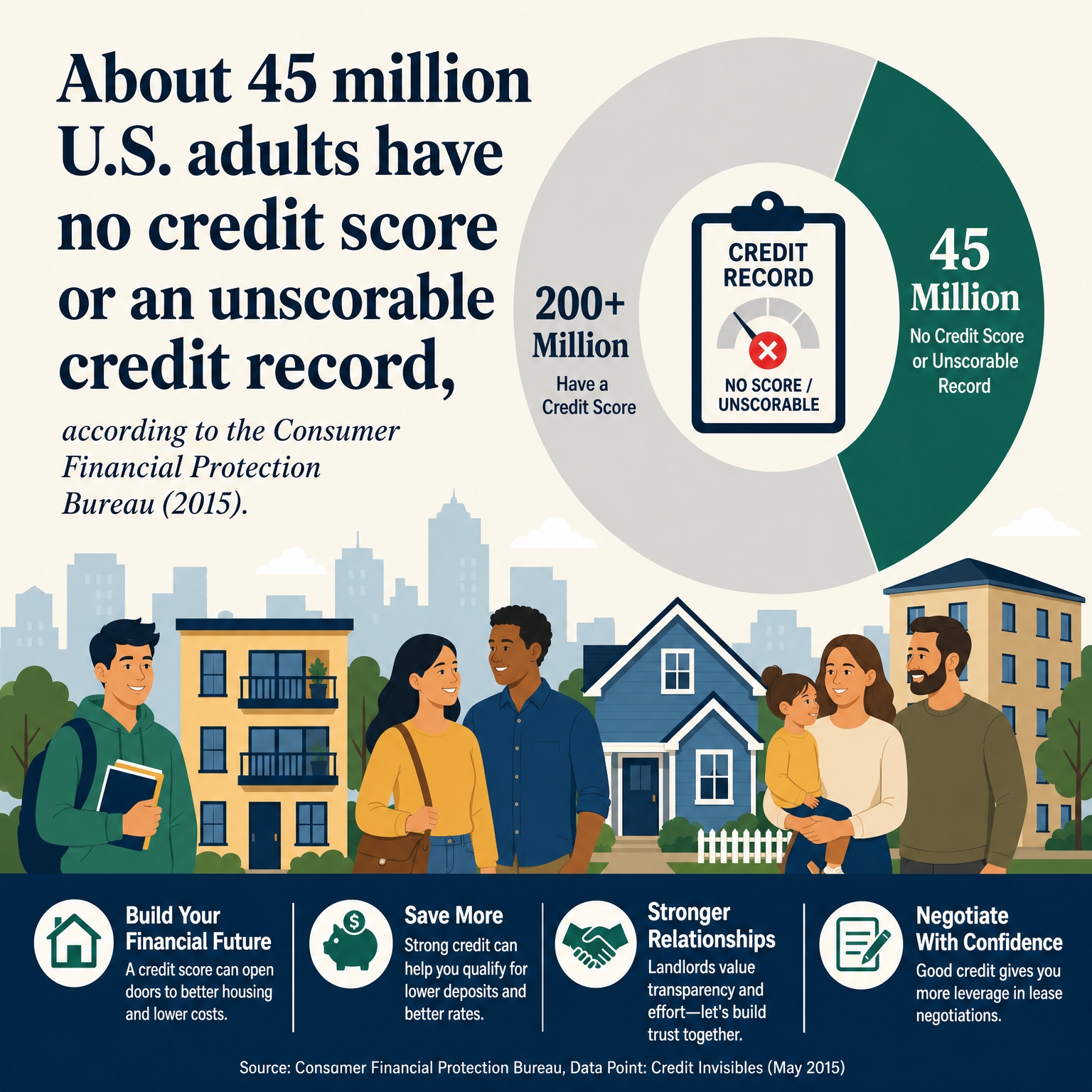
I had a client last month who was a grad student with a stipend. Totally legit money. But the leasing agent didn’t know what they were looking at and mentally filed it under “unverified.” We fixed it with one document and a two-sentence note. Approved the next day.
Common friction points for students
- No or limited credit file
- Income from scholarships, stipends, family support, or part-time work
- No prior landlord references
- Multiple roommates, multiple stories, multiple chances for confusion
And for first-time renters who aren’t students? Different flavor. Maybe you have income but no rental history. Or you have credit, but it’s new credit with a few bumps.
Build an application packet that makes approval easy
Real talk: the “application” is only part of what gets you approved. Your packet does the heavy lifting. When you hand someone everything they need up front, you reduce the back-and-forth. Landlords love less work.
We recommend you prepare this before you tour seriously. Not after you fall in love with a place and start panic-scanning PDFs at midnight.
What to include in your packet
Proof of income. Paystubs, offer letter, bank statements if needed. For students, that might be a financial aid award letter, stipend letter, or scholarship documentation. Keep it clean. Highlight the line that shows recurring support.
Proof of identity. ID, plus whatever the property asks for. Some use third-party screening portals. Annoying. Normal.
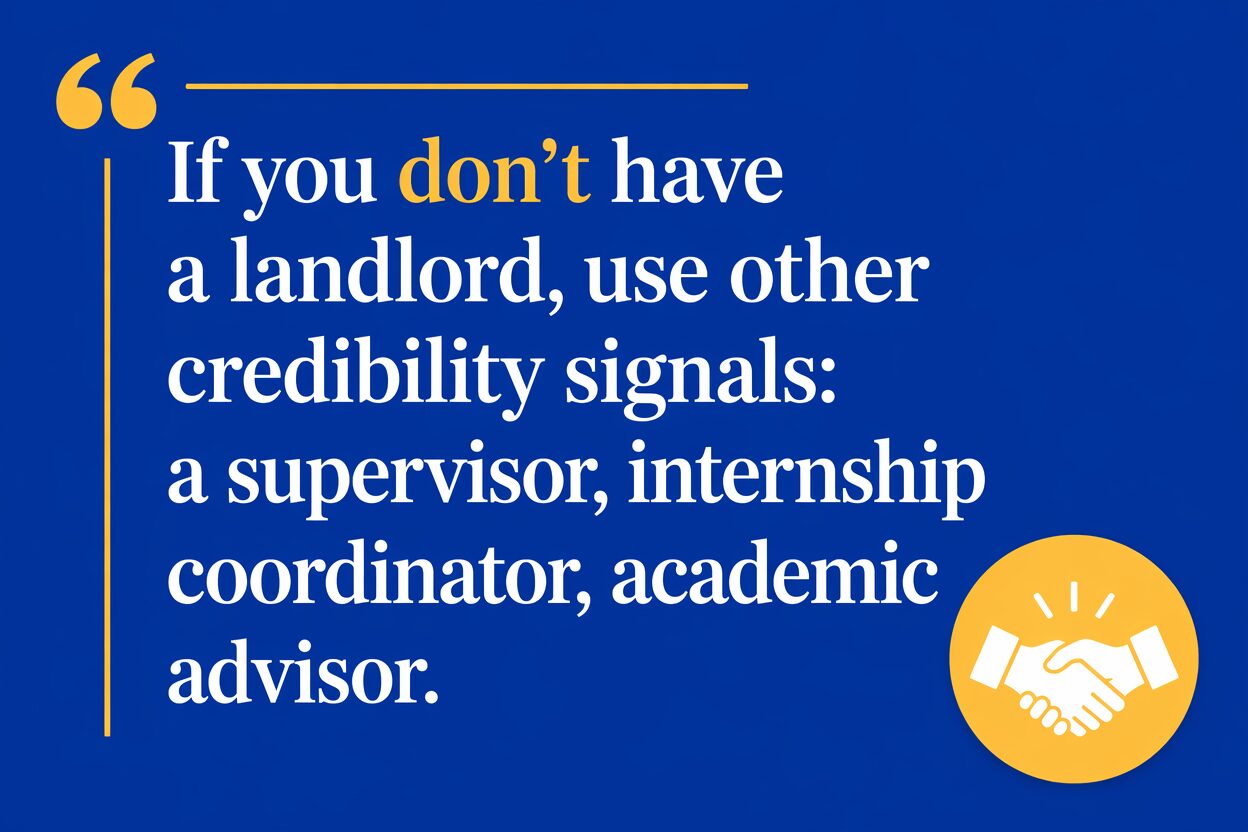
Rental references. If you don’t have a landlord, use other credibility signals: a supervisor, internship coordinator, academic advisor. Not your best friend. Please don’t do that.
Short cover note. Not a memoir. Four to six sentences. Who you are, what you do, why you’re moving, and one calm reassurance about paying on time.
Speed matters more than most renters think. Redfin reports that about 1 in 3 U.S. renters (33.6%) have lived in the same home for at least 5 years, up from 27.8% in 2006. When a good unit opens up, it can attract applicants fast. So when they do, applicants show up.
Credit and no-credit situations without spiraling
Honestly? I used to think a thin credit file was the end of the road. Turns out it’s just a different category. Landlords usually have a playbook for it: higher deposit, guarantor, or extra documentation.
But you can influence which option they choose. How? You make risk feel contained.
What helps when you have no credit
- Show consistent bank balances over time (not one big random deposit)
- Provide proof of enrollment and expected graduation date (stability signal)
- Add references that speak to reliability
- Offer a guarantor proactively when you know it’ll be required
And don’t try to “explain” no credit like it’s a moral issue. Keep it simple. “I’m a first-time renter and haven’t used credit much.” Done.
What hurts, even when your score is fine
One late payment might be nothing. Five late payments tells a story. So does maxed utilization. Or a recent collection.
If there’s a blemish, a short note can help. Short. Calm. “Medical bill hit while I was uninsured, it’s paid now.” That kind of thing. And our partner, Rental Kharma, can also help with credit score improvement strategies.
Guarantors, co-signers, and how to avoid awkward surprises
But let’s talk about the thing that gets families stressed. The guarantor.
Most student renters don’t realize the guarantor is basically applying too. Landlords often run the same checks. Credit. Income. Usually, the guarantor pays an application fee as well.
Here’s what we tell parents and renters: treat the guarantor step like its own mini-application. Get the documents ready. Decide who’s doing it before you apply. You don’t want to win the apartment and then lose it because Dad is traveling and can’t sign for four days.
What landlords usually want from a guarantor
- Proof of income (W-2, paystubs, or tax return pages)
- Credit check authorization
- Signed guaranty agreement
One exception: some properties won’t accept guarantors for roommate setups unless every roommate has a guarantor. It’s a policy thing. Not personal. Still annoying.
Using scholarships, grants, and “nontraditional” income
So, can you list scholarships as income? Usually yes, in some form. But you can’t just write “$X scholarship” and hope they interpret it the way you do.
What actually works is showing it as documented, recurring support tied to the lease term. If your award letter covers the academic year and your lease is 12 months, call that out. In plain language.
And family support? It’s common. The trick is documentation. A simple support letter can help. Some landlords will ask for proof of transfers. Don’t be offended. They’re trying to position your application so they can defend it when their boss asks about it.
A simple way to frame mixed income
We like a one-page “income summary” attached to the application. A tiny table. Source. Frequency. Documentation attached. It keeps your story from getting scattered across 12 PDFs.
Also, don’t inflate. Landlords can smell rounding and hand-waving. It makes them suspicious of everything else.
Roommates and joint applications without chaos
Roommates can save you a ton. The group application can also blow up in your face.
Here’s the part renters miss: the weakest applicant can sink the whole group when the property uses a “group approval” standard. Some places approve each roommate individually. Some don’t.
Make the roommate plan boring
- Pick one person to coordinate documents
- Make sure everyone uses the same move-in date and unit number
- Submit at the same time (or as close as possible)
- Agree on who pays what before you apply
I’ve seen groups lose a unit because one roommate forgot to upload ID. That’s it. That was the reason. The leasing team moved on to the next complete application.
Negotiation starts earlier than you think
Now, this is where Rental Secrets gets excited. A strong application isn’t just about approval. It’s a negotiation tool.
Landlords discount risk. When you present as low-risk, you sometimes get flexibility: a smaller deposit, a waived condition, a slightly better lease term. Or yes, occasionally a rent concession when the market supports it.
We don’t mean you walk in and demand a price cut on day one. Not that. We mean you build credibility first, then ask for something reasonable. Timing matters.
If you want the broader playbook, jump to our guide to rental housing applications for renters and landlords. That’s where we lay out how screening, market conditions, and negotiation fit together.
Little lines that work when you ask for a better deal
Try: “We’re ready to apply today. If we sign by Friday, is there any flexibility on the terms?”
Or: “We can do a longer lease if that helps. Would you adjust anything on the monthly fees?”
Not magic. But it signals seriousness. And landlords like certainty.
Landlords and managers reading this can make it easier too
Yep, we talk to landlords and property managers too. Better tenant relationships usually start at the application stage. This is where trust gets built or broken.
If your application process is confusing, renters assume you’ll be confusing to deal with later. Maintenance. Renewals. Deposits. The whole relationship.
Simple changes that reduce friction
- List acceptable income documents for students (award letters, stipends, support letters)
- Say upfront when a guarantor is required and what standards apply
- Explain whether roommates are screened individually or as a group
And if you want fewer flaky applicants, respond fast and clearly. Even a short message helps. Silence creates chaos. Chaos creates ghosting.
Closing thoughts and your next move
Here’s the takeaway we keep coming back to: your goal isn’t to be perfect. Your goal is easy approval. Clean story. Complete packet. Calm explanations for the weird stuff.
Do that, and you’ll spend less time getting rejected and more time doing the part that actually saves money. Picking the right unit. Asking for better terms when it’s realistic. And walking into a lease with your eyes open. That’s the whole thing.
Disclaimer: This article does not constitute legal advice.