

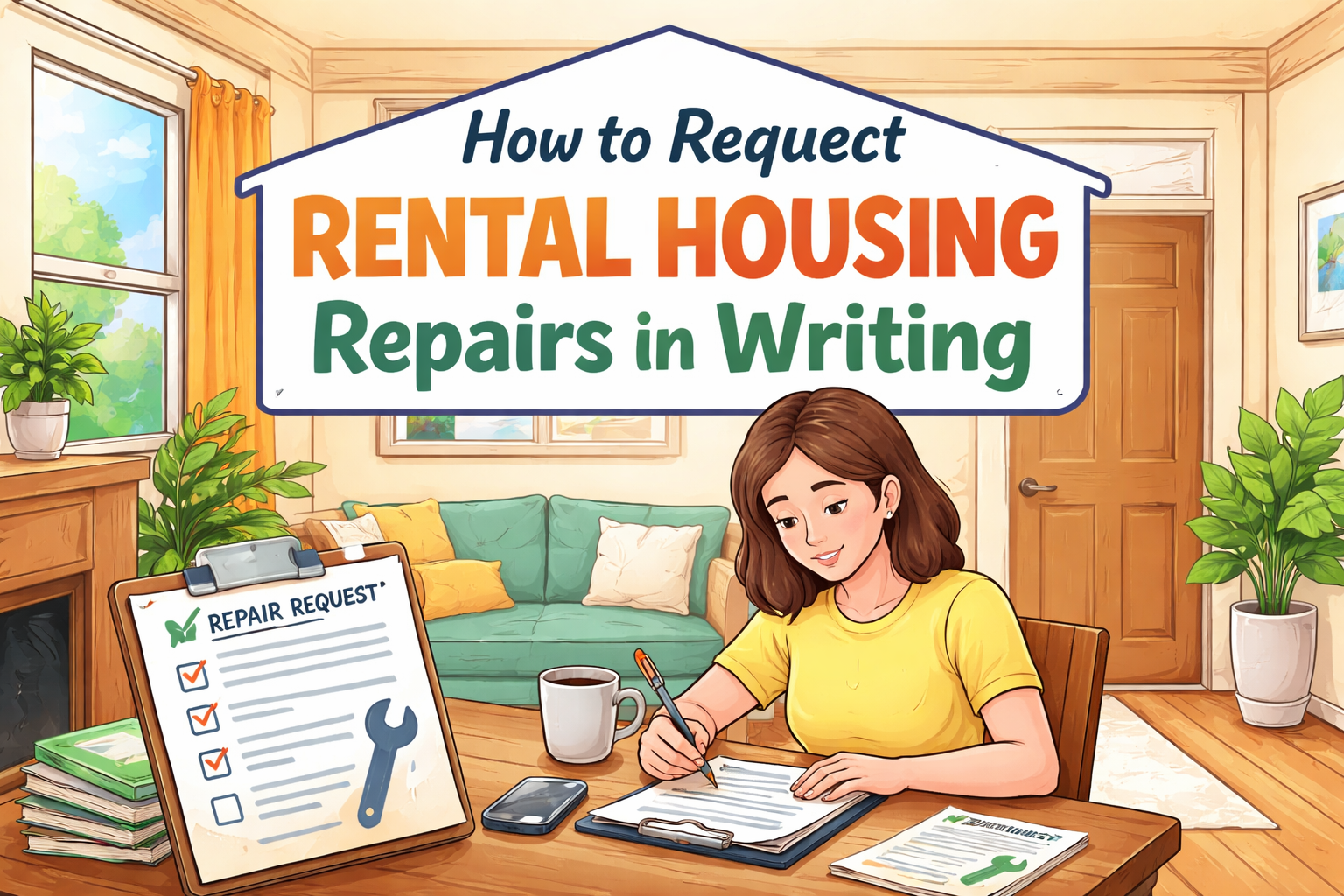
Send the repair request in writing. Every time. Even when you’re on friendly terms. Verbal asks are how repairs drift into the void.
And yes, it can feel awkward. Like you’re being “that tenant.” Real talk: the tenant who documents things is the tenant who gets results. At Rental Secrets, we’ve seen this over and over. The renters who stay calm, clear, and paper-trailed usually get faster fixes. They also protect their budget because small issues don’t turn into expensive disasters.
Write it like a business email not a rant
Look, you don’t need legal language. You need clarity. When I help clients draft these, I’m not trying to sound fancy. I’m trying to make it easy for a landlord or property manager to say “yes” and forward it to maintenance in 10 seconds.
Use a subject line that forces action
Don’t bury the lead. A subject line like “Repair request: leaking kitchen sink in Unit 3B” beats “Hi” by a mile. Property managers triage. You want your message to land in the “real problem” pile, not the “later” pile.
Include the details maintenance actually needs
Most people write feelings. “This is so frustrating.” I get it. But maintenance needs facts. What’s broken. Where. When you noticed it. And what the impact is (water damage risk, no heat, etc.).
Keep the tone neutral. Not cold. Neutral. You can be human without being messy.
- What’s the issue and exact location
- When it started or when you noticed it
- Any immediate risk (leak spreading, sparks, no hot water)
- What you’ve done already (shut off valve, reset breaker)
- Your availability windows for entry
One more thing. Photos. Always. Attach them. Mention them. “Attached are two photos from 3/9 at 7:15pm.” That’s the kind of detail that stops arguments later.

Pick the right delivery method so it counts later
Thing is, “in writing” can mean different stuff depending on your lease and your local rules. Email is usually fine. Tenant portals are fine too. Text can work, but it’s the flimsiest option unless your landlord consistently uses it for official communication.
Check your lease for the official notice clause
Some leases have a section that says notices must be sent to a specific email, address, or portal. People skip this. Then a landlord says, “We never got it.” Annoying. Avoidable.
If you’re already reading up on the legal basics, our tenant rights and legal basics resources can help you spot those little lease clauses that matter more than they look.
Email plus portal is our favorite combo
In our experience, the best approach is redundancy. Submit through the portal. Then email a copy. Short. Polite. With the portal ticket number in the email.
Why? Portals can be hard to search. Emails are easy to forward. And if someone leaves the management company, you still have your sent folder.
And please don’t only call. A phone call is fine as a heads-up. But get the written request in right after. Same day.
Use wording that gets a yes and protects your budget
Honestly? This is where people accidentally sabotage themselves. They write like they’re trying to win an argument. Landlords don’t “lose” arguments. They delay. Or they get defensive. Or they decide you’re high-maintenance and not worth renewing. None of that helps your rent negotiation power later.
We’re big on a mindset shift at Rental Secrets. You’re not begging. You’re managing a shared asset. You’re also helping the owner prevent bigger repair bills. That’s not manipulation. That’s reality.
Ask for a plan and a timeline
Instead of “Fix this ASAP,” try: “Can you confirm when maintenance can come by?” Or “What’s the expected timeline for repair?” You’re still pushing. You’re just doing it in a way that invites a concrete response.
And if it’s urgent (no heat, electrical issues, active water leak), say that plainly. Don’t dramatize it. Just state the risk and what you’ve done to reduce harm.
Don’t threaten legal action in the first message
Legal threats too early don’t speed up the process. In fact, they often slow things down. The message gets forwarded to “someone higher up,” everyone gets cautious, and you’re suddenly stuck in paperwork land.
Save the escalation language for later, after you’ve got a clean record of requests and non-response. Most of the time, you won’t need to go there.
If you want the broader playbook on how we think about landlord incentives, timing, and negotiation posture, that’s all baked into our main rental housing guide for renters and landlords. It’s the stuff most people never get told.
Follow up like a pro when they ignore you
So you sent the message. No reply. It happens. Property management is chaotic. Vacancies. Vendor no-shows. Someone’s kid got sick. Still. Your issue is your issue.
Use a short follow-up cadence
We like a simple pattern: follow up in 48 to 72 hours for non-urgent items. Faster for urgent habitability stuff. Keep the follow-up even shorter than the first message.
Example vibe: “Hi [Name], circling back on the leak under the kitchen sink I reported on Monday. Any update on scheduling?”
Chill. Persistent. Documented.
Escalate the channel before you escalate the tone
Try a different channel next. Portal message plus email. Then a call where you reference the written request (“I emailed on Tuesday at 9:12am, subject line ‘Repair request…’”). It signals you’re organized.
And if they do respond with a vague “We’ll get to it,” ask one more time for the date window. You’re not being difficult. You’re being schedulable. Landlords like schedulable.
Copy and paste templates that actually work
Here’s what I’d send. Edit the brackets. Keep the structure. Don’t overthink it.
Template for a normal repair
Subject: Repair request: [issue] in [location], Unit [#]
Hi [Landlord/Manager Name],
I’m requesting a repair for [describe the issue] located at [exact location] in Unit [#]. I first noticed it on [date/time].
Impact: [briefly describe impact, like “water is pooling under the cabinet” or “the outlet is not working”]. Photos are attached.
Please let me know the earliest time maintenance can come by. I’m available [two or three windows]. You can enter with notice per the lease.
Thanks,
[Your name]
[Phone number]
Template for urgent issues
Subject: Urgent repair request: [no heat / active leak / electrical issue], Unit [#]
Hi [Landlord/Manager Name],
I’m reporting an urgent maintenance issue in Unit [#]: [what’s happening] as of [date/time].
Safety or damage risk: [one sentence]. I’ve already [what you did, like “shut off the water valve”]. Photos/video are attached.
Can you confirm receipt and the plan for repair today? I can be available [windows] for entry.
Thanks,
[Your name]
[Phone number]
And yes. Put “confirm receipt” in there. It’s a small line. It changes the whole dynamic.
FAQs for How to request rental housing repairs in writing
Should I send repair requests by text message?
Text is okay for quick coordination. “Maintenance is here, can I buzz them in?” For the actual request, we prefer email or the tenant portal. Text threads get lost. Phones get replaced. And screenshots aren’t as clean as a timestamped email chain.
What if I’m worried the landlord will retaliate or refuse to renew?
That fear is real. We hear it constantly. Here’s the practical angle: a calm, factual repair request is the least inflammatory thing you can send. No accusations. No threats. Just a documented problem and a request for scheduling.
Also, landlords tend to value tenants who prevent property damage. A quiet leak can cost thousands. Your email can save them from that. If you’re still uneasy, keep everything in writing and stay consistent. Organized tenants are harder to push around. Even the difficult landlords notice.
Disclaimer: This article does not constitute legal advice.