
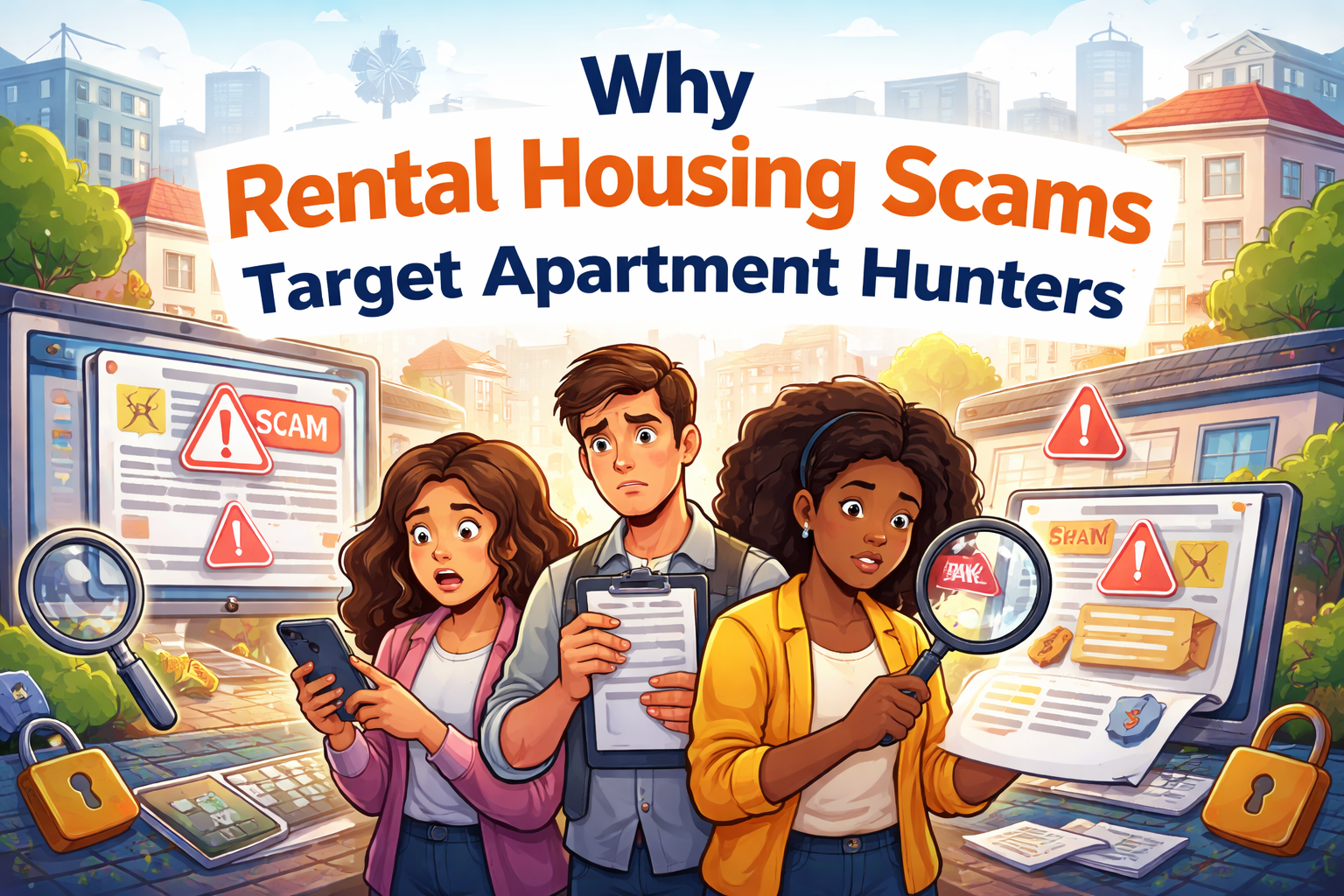
Rental scams don’t hit apartment hunters by accident. They hit you because you’re busy, you’re stressed, and you’re trying to save money. And when you’re juggling a job, classes, kids, a commute, or all of the above, you don’t always have the energy to be a human lie detector.
We’ve worked with renters who paid a deposit and rent for four months only to find the “landlord” didn’t own the property, forcing them to move again unexpectedly. We’ve also seen landlords who were furious because scammers used their real listings to trick people. Same mess. Different side of the table.
Apartment hunters are a perfect storm of pressure and urgency
Look, scams work best when you feel rushed. That’s the whole thing. Apartment hunting creates artificial urgency even when nobody says the word “urgent.” Your lease is ending. Your roommate is bailing. Your kid’s school starts soon. Your budget is already tight. So your brain starts making deals with itself.
I’ve watched it happen in real time with clients. They’ll tell me, “I have to lock something in today.” And I get it. But that sentence is basically a welcome mat for scammers.
Scarcity hits harder when rent eats your paycheck
When you’re cost-conscious, you’re not casually browsing. You’re hunting. You’re filtering for “under $1,800” or “includes parking” or “no broker fee.” You find one unicorn listing and your heart rate spikes. That emotional spike is what scammers are counting on.
And here’s the nasty part. People who can’t afford to lose money are more likely to take a risk to avoid losing the apartment. It’s backwards. But it’s human.
New renters get targeted because the rules feel fuzzy
Students and first-time renters tend to assume the process is a little informal. Like buying something on Facebook Marketplace. Quick chats. A Venmo. Done. Scammers love that expectation because it lowers your guard.
Most legitimate landlords and property managers have a process. Application. Screening. Lease. Funds at signing. The order matters.

Scammers follow the money and the emotion
Scammers aren’t guessing. They’re picking the juiciest moment. High demand neighborhoods. Summer move-in season. The first week of the semester. After a big employer relocates people to town. Any time the market feels like a stampede.
We’re Rental Secrets. We teach renters to treat renting like a negotiation, not a shopping trip. Part of that mindset shift is realizing you’re not just “trying to win an apartment.” You’re evaluating a business relationship. Scammers don’t want relationships. They want one payment and a disappearing act.
They copy real listings because it’s fast and believable
This bugs me because it’s so lazy. They’ll pull photos and descriptions from a real listing, sometimes from an MLS feed, sometimes from a property management website, sometimes from an old Zillow page. Then they repost it with a slightly lower rent. Just low enough to make you think you found a deal. Not so low that you instantly scream “fake.”
And if you’ve been apartment hunting for weeks? That “slightly lower” number can feel like oxygen.
They design the story to block verification
You’ll hear scripts like: “I’m out of town.” “I’m on a mission trip.” “I’m deployed.” “My agent has the keys but they’re busy.” It’s always something that prevents a normal tour and a normal verification loop.
Then they steer you toward a payment method you can’t reverse. Wire. Gift cards (yes, still). Zelle to a random name. Crypto. Anything that turns your money into smoke.
The scam tactics that show up again and again
Honestly? The details change. The shape of the scam stays the same. Over and over.
They try to get money before you have control
Control means keys. A signed lease. A verified owner or manager. A traceable payment path. Scammers want the opposite. They want you paying while you still have zero leverage.
Here are the red flags we see most often (and yes, legit deals can have one of these. But two or three together? Yikes):
- They won’t do an in-person or live video tour of the exact unit.
- They push you to pay a “holding deposit” immediately to “stop the showings.”
- The name on the payment account doesn’t match the owner, brokerage, or management company.
- They avoid a standard rental application and screening process.
- They get weird when you ask for a lease draft before paying anything.
They weaponize your fear of being outbid
“I have three other applicants.” “Someone’s coming with cash.” “If you can pay in the next hour, it’s yours.”
Real talk. In hot markets, landlords do move fast. We see it. But reputable operators don’t need to bully you into irreversible payments. They can take an application fee through normal channels. They can provide written criteria. They can schedule a showing. They can identify themselves.
If you’re trying to get your rent down, this matters even more. Because the same urgency that tricks you into overpaying for a scam can also trick you into signing a real lease that’s too expensive. Different problem. Same trigger.
How renters can protect themselves without becoming paranoid
Most people swing between two extremes. Trust everyone. Trust nobody. Neither works.
We prefer simple verification steps that don’t take forever. Stuff you can do on a lunch break. Stuff that still leaves room for a normal, friendly relationship with a future landlord.
Verify the person before you “fall in love” with the unit
When I work with clients on this, the first thing I check isn’t the granite countertops. It’s who we’re dealing with. Name. Company. Ownership. Paper trail.
A few practical moves:
Ask for a live video walkthrough. Not a prerecorded clip. Live. Have them open a closet, pan to the street sign, show the unit number on the door. Small requests. Hard to fake.
Match the listing to the owner/manager. County property records are usually public. If the “owner” can’t explain the connection between their name and the deed, slow down. Some owners use LLCs. Fine. They can still explain it.
Use the building’s real phone number. If it’s a managed building, call the management office from the official website. Not from the listing. Not from a text.
And if you want a broader framework for how renters and landlords think during this process, our rental housing guide for renters and landlords lays it out in plain English. No fluff.
Protect your money like it’s rent money. Because it is
We’re not anti-deposit. Deposits are normal. Holding fees can be normal too (market-dependent). But the timing and the method matter.
In our experience, a safer pattern looks like this: verified tour, verified identity, application, approval, lease signing, then funds at signing through a traceable method. Credit card portals, checks to the correct entity, and established payment platforms tied to the management company. That sort of boring adult stuff.
Also, keep screenshots. Save the listing. Save texts. If things go sideways, documentation is what helps your bank, your payment app, and sometimes law enforcement take you seriously.
What landlords and property managers can do to stop scammers from using their listings
Landlords hate scams too. Not because they’re saints. Because it wrecks trust. It wastes time. It creates angry prospects who think the real landlord is the scammer.
We’ve had property managers tell us they spent days calming down people who got tricked by a fake listing using their photos. That’s not a marketing problem. That’s a reputation problem.
Make verification easy for legitimate prospects
Here’s a simple idea that works shockingly well. Put a verification line in your listings and on your website.
Something like: “We never ask for deposits via wire or gift cards. Tours are scheduled through our office at [official number]. Payments only through [portal].”
It sounds basic. It helps renters breathe. And it separates you from the random person texting from a burner number.
Control your photos and posting footprint
Scammers need your photos. Don’t make it effortless. Watermarking can help. So can posting a limited set of images publicly and keeping the full gallery inside verified platforms.
And if you manage multiple units and you’re trying to reduce churn, trust is part of retention. The renter who feels safe during leasing tends to stay longer. That’s not always true. But it tends to be.
If you want more on how to screen rentals and keep the process clean, our rental finding and screening resources go deeper into the real-world steps that protect both sides.
FAQs for Why rental housing scams target apartment hunters
Is it ever okay to pay a holding deposit before signing a lease?
Sometimes, yes. It depends on the market and the operator. The part we care about is verification and paperwork. You want a written agreement that explains whether it’s refundable, how long it holds the unit, and what happens if either side backs out. And you want to know you’re paying the actual owner or management company. Not a stranger with a payment handle.
What if the unit is real, but the person I’m talking to feels off?
That’s common. A scammer can be attached to a real address. Don’t let the reality of the unit talk you out of your instincts. Switch channels. Call the property manager from the building’s official site. Walk into the leasing office. Ask for ID at the showing. Normal landlords won’t love being treated like a suspect, but most will understand. The ones who explode? That tells you something too.
Disclaimer: This article does not constitute legal advice.