

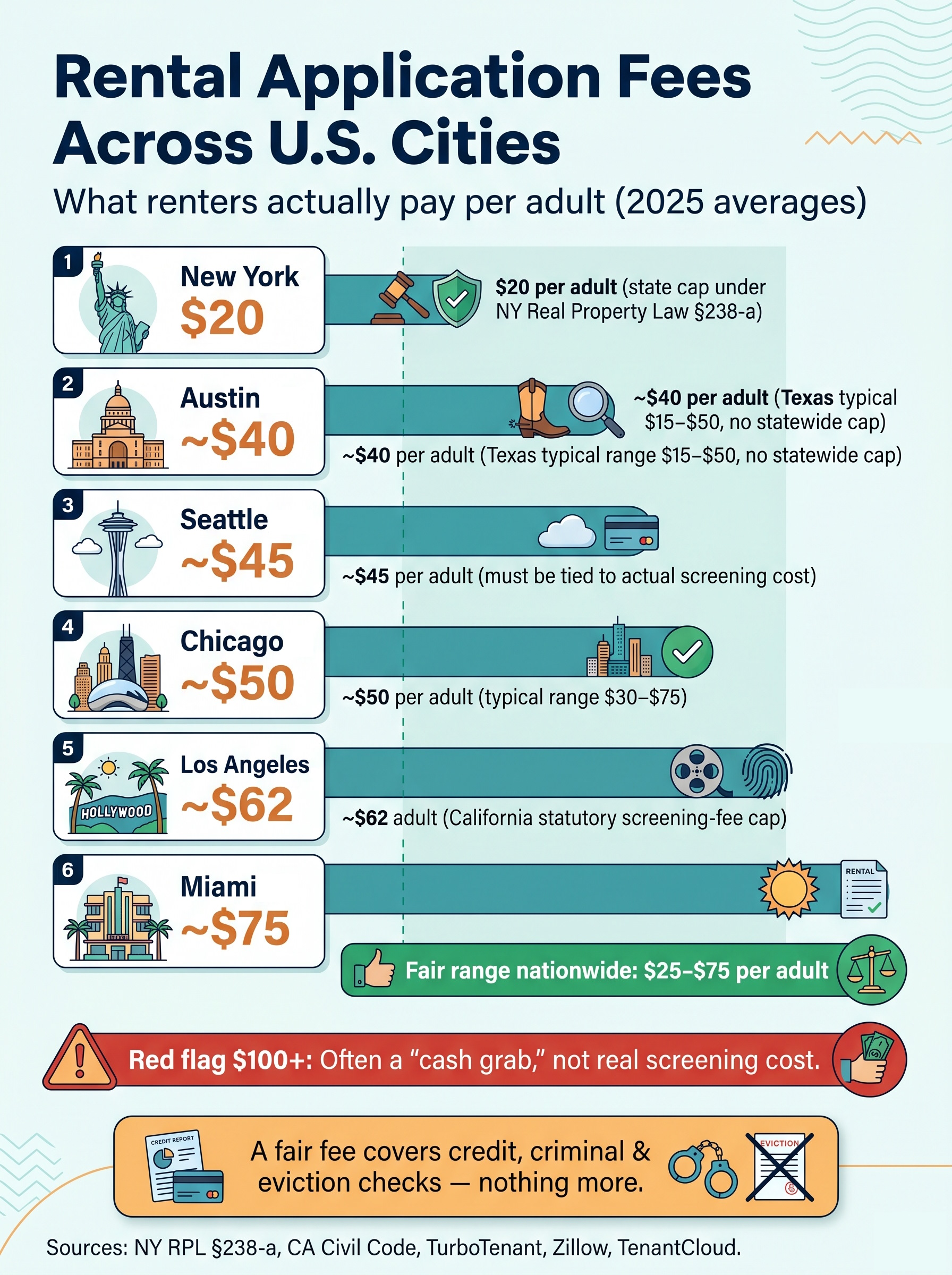
Rental application fees should feel boring. Like, “yep, that covers the background check.” Not like a mini security deposit that vanishes into the void. Most of the time, a fair fee lands in the $25 to $75 per adult range. Higher can be legit in some markets. Or it can be a cash grab. You need a way to tell the difference.
What a normal application fee actually covers
Here’s the thing. A real application fee is supposed to reimburse real screening costs. Not pad someone’s monthly income. When we’re talking “normal,” we’re talking about what it costs a landlord or manager to run screening and process the file. Boring admin stuff.
Typical cost buckets landlords pay for
Most screening packages bundle a few reports. Credit. Criminal. Eviction history. Income verification. Sometimes ID verification (especially with larger management companies that are tired of fraud).
When I work with clients on this, the first thing I ask is: what did they actually run? A surprising number of listings say “application fee” but don’t say what you’re buying.
So what’s a fair dollar amount
In our experience, $25 to $50 per adult is the most defensible range when the landlord is using standard tenant screening. $50 to $75 can still be reasonable in pricier cities or when they’re using a more expensive service, especially if the property is managed professionally and they’re doing identity verification too.
Once you’re hearing $100+ per adult, we start asking harder questions. Not because it’s impossible. Because it’s often where “screening” turns into “profit center.”

When fees get weird and how to spot a cash grab
Some fees are legit high. Many aren’t. And renters usually feel it in their gut. You know that moment when you’re like, “Wait. Why am I paying $250 just to be considered?” Yeah.
Red flags we see over and over
- They won’t tell you what reports they run (or who runs them).
- They collect fees from lots of applicants at once and won’t disclose where you are in line.
- The fee is “nonrefundable no matter what,” even if they never screen you.
- They stack extra “admin” or “processing” fees on top of the application fee.
- They push you to pay before you’ve toured or seen basic lease terms.
Honestly? The biggest tell is urgency. “Pay now or lose it.” That pressure often means they’re not picky about who applies. They’re picky about collecting fees.
What high-fee setups can indicate
Sometimes it’s a high-demand unit and they’re trying to slow the flood of applicants. Sometimes it’s a management company following a rigid corporate pricing sheet. But sometimes it’s a landlord who already has a likely tenant and is still taking applications. I’ve seen this happen. It’s ugly. And the renter usually finds out when the unit “just got taken” right after they pay.
If you want the bigger picture on how these upfront charges tend to show up, we keep a running breakdown on rental application fees and other upfront costs. It helps to see the patterns.
How to ask about fees without sounding like a problem tenant
Look, asking about money doesn’t make you difficult. It makes you functional. But wording matters. Especially if you’re dealing with a small landlord who’s already suspicious of “negotiators.”
Questions that get you real answers
Try something like:
“Quick question. Does the application fee cover credit, criminal, and eviction checks? And will you run it right away or only after you’ve reviewed the first application?”
That’s calm. Specific. Not accusatory.
Another one we like:
“How many applications are you taking before you decide? I’m trying to budget and avoid paying fees if the spot’s basically filled.”
Most reasonable landlords will answer. If they dodge, that’s information too.
How landlords can make this easier and still protect themselves
Our team at Rental Secrets talks to landlords and property managers too. The ones with the best retention tend to do one simple thing. They set expectations upfront. How many applications they’ll accept. When screening happens. What the fee covers.
I used to think transparency would “invite arguments.” Turns out it prevents them. Less angry follow-up. Less drama at move-in. Better reviews. People remember being treated like an adult.
What renters can do to keep application fees from wrecking their budget
Application fees add up fast. Two adults applying to three places? That can be hundreds of dollars. And that’s before deposits, movers, and the “why does everything cost money” moment.
Pre-screen yourself before you pay
Most people skip this. Then they get denied for something predictable and the fee is gone.
We recommend you do a quick self-audit. Credit score range. Any old collections. Past eviction filing (even if you “won”). Income math vs rent. Pet situation. And the big one: whether your employment can be verified cleanly.
One exception. If you’re a student or you’ve got nontraditional income, don’t assume you’re dead on arrival. You might need a guarantor. Or a larger deposit. Or a shorter lease. But you want that conversation before you pay three application fees and hope based on vibes.
Batch your effort, not your spending
Apply strategically. Not emotionally. I get it. You tour a place and you can already picture your couch in the corner. But if the landlord is taking “multiple applications” and won’t say where you stand, you’re basically buying a lottery ticket.
This is where knowing how landlords think saves you money. At Rental Secrets, we teach renters the market-based signals that show whether a unit is truly competitive or just marketed that way. Sometimes the “hot” listing has been sitting for 30 days and the landlord’s quietly flexible. That’s rent negotiation territory. And yes, it connects to fees too. Less desperation. Fewer panic applications.
If you want the broader strategy around applications, screening, timing, and how to communicate like someone who gets it, check our main guide to rental housing applications. It’s the stuff we wish everyone knew before they started throwing money at fees.
Fee rules vary by state and city, so know your leverage
Real talk: what’s “allowed” and what’s “reasonable” aren’t the same thing. Some places cap application fees. Some require itemized receipts. Some limit fees to actual screening cost. And some barely regulate it at all.
What laws commonly do and don’t require
Laws, where they exist, tend to focus on a few ideas. Fees can’t exceed a cap. Landlords may need to give a receipt or disclose what the fee is for. Sometimes they must refund it if they don’t run the screening. But many areas leave it fuzzy.
And yes, enforcement can be hit or miss. So the practical move is usually this: ask questions early. Get the policy in writing (text or email is fine). Decide if the unit is worth it.
How landlords can use fair fees as a trust signal
From the landlord side, a fair, clearly explained fee is a relationship win. You filter out the applicants who aren’t serious. You don’t torch goodwill with the serious ones. That goodwill matters later. Renewal conversations. Maintenance requests. Payment hiccups. The whole relationship gets smoother.
We’ve seen landlords lower fees and still get great applicants. They just tighten process. One showing window. Clear minimum criteria. One screening run per finalist, not ten. It’s not magic. It’s just clean operations.
FAQs for How much should rental application fees cost
Can a landlord charge an application fee per person
Usually, yes. Most screening is run per adult because reports are tied to an individual. The part that gets messy is when they charge per person but don’t actually screen everyone, or they collect a pile of fees from multiple households and screen only one. Ask when screening happens and who gets screened.
Are application fees refundable if I’m denied
Most of the time, no. The fee is typically framed as paying for the screening itself, not paying for approval. But if they never ran the screening, some jurisdictions require a refund, and some landlords will voluntarily refund when they realize they’re not going to process your application. Get clarity before paying. A simple “Do you run the reports immediately?” goes a long way.
Where we land on a fair fee and what to do next
Most renters shouldn’t accept mystery fees. A fair application fee is usually $25 to $75 per adult, tied to real screening, with a clear process for when it’s run. If a landlord can’t explain it, that’s not your cue to be “chill.” It’s your cue to protect your budget.
And if you’re applying to multiple places, don’t just pay and pray. Get smarter about which units are actually competitive and which ones are negotiable. That’s the kind of thinking we teach at Rental Secrets. It saves money fast. Sometimes on fees. Often on rent.
Disclaimer: This article does not constitute legal advice.