

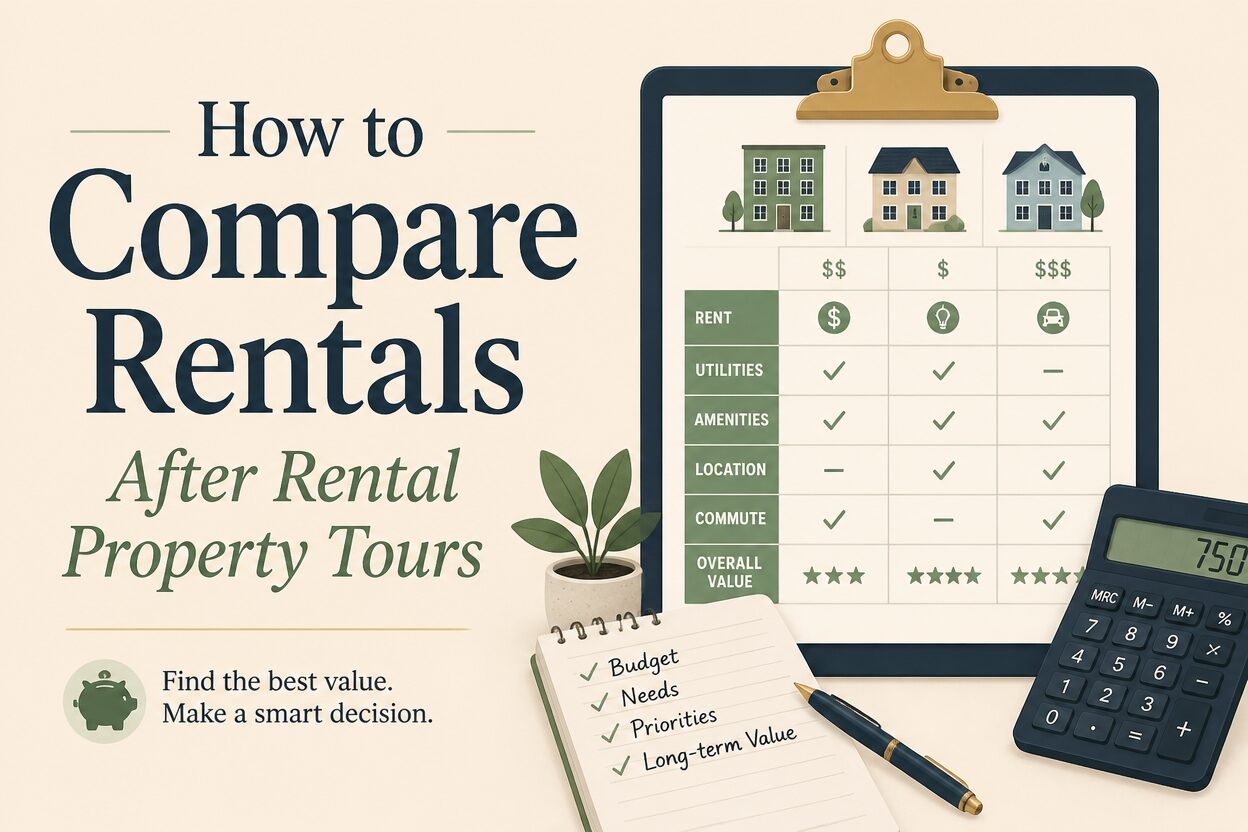
Walk out of three tours and your brain turns to soup. Same beige carpet. Same “lots of natural light.” Same weirdly tiny fridge. So here’s the move. You compare rentals like you’d compare phone plans. Not vibes. Costs, trade-offs, and what’s actually going to hit your bank account every month.
And yeah, we’ve watched renters fall in love with a place and then get blindsided by the stuff that never shows up in the listing. Parking. Utilities. Fees. A laundry situation that’s basically a part-time job. Let’s keep that from being you.
Build a comparison sheet you will actually use
Look, keep it dead simple. You don’t need a fancy spreadsheet template that makes you feel like you’re doing corporate finance. You need something you’ll open again at 11:47 pm when you’re anxious and second-guessing everything.
Start with three buckets
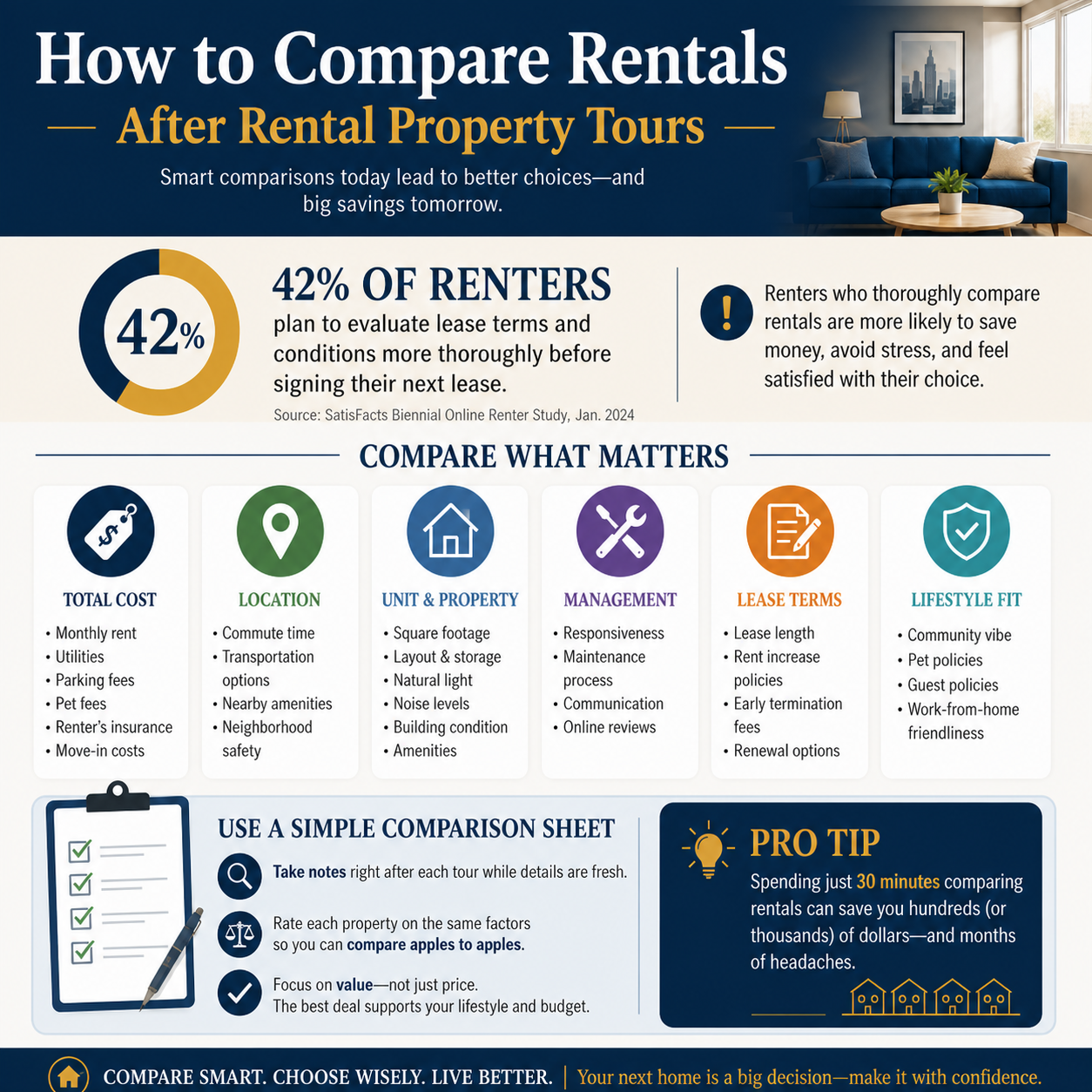
When I work with clients on this, I tell them to sort everything into: fixed monthly costs, variable monthly costs, and one-time costs. That’s it. If you mix them together, you’ll “forget” the move-in fee exists. Convenient. Expensive.
- Fixed monthly: base rent, required parking, pet rent, storage unit
- Variable monthly: electric, gas, water, trash, internet (and whether you can choose)
- One-time: application fee, admin fee, security deposit, move-in fee, pet deposit
Keep a notes column too. Just a little one. That’s where you write stuff like “hallway smells like fried food,” or “train horn at 6 am,” or “manager dodged my question about renewal increases.” Those notes matter.
Use a scoring rule, not a feeling
I used to tell people to score each place 1 to 10. Turns out that gets mushy fast. Everything ends up a 7. Do this instead. Pick 5 must-haves and score them pass/fail. No in-between.
Example must-haves: in-unit laundry, commute under 30 minutes, total move-in under $3,000, allows a cat, safe parking. Whatever your life requires.
Then you can still have favorites. You’re human. But you’re not letting a “cute backsplash” bully your budget.

Convert every tour into a true monthly number
Rent is the headline. Your checking account pays for the full article.
Our team at Rental Secrets is obsessed with this part because it’s where negotiation gets real. You can’t push back on costs you haven’t identified. Landlords know that. They’re not evil. They’re just… practiced. They do this every…single…day.
Ask for the fee list in writing
On the tour, say it casually: “Can you email me the full fee schedule and what utilities are included?” If they can’t, that’s already information.
And don’t accept “it depends” without follow-up. Depends on what. Season? Usage? Lease length? Which unit? This bugs me because renters blame themselves later for not “understanding,” when the info was just withheld or vague.
Do the annoying math right away
Here’s what I do in my own notes, immediately after the tour, sitting in my car. I estimate:
True monthly cost = rent + fixed monthly fees + average utilities – monthly value of concessions
Concessions are sneaky. “One month free” isn’t one month free. It’s usually spread across the lease, or it’s a credit after you’ve already paid. So you convert it to a monthly number. Example: $1,800 rent, one month free on a 12-month lease. That’s basically $150 off per month in value. Basically.

If you want the bigger framework for what to capture during and after tours, we keep it organized in our rental property tours guide for budget-smart renters. That’s the stuff we use with clients when they’re comparing multiple options fast.
Compare the stuff listings love to hide
Now we get into the “okay but what’s it like to live there” costs. Not emotional costs. Actual ones. Time. Hassle. Surprise spending.
Laundry, parking, and package delivery
Laundry is a money leak in disguise. No in-unit laundry can still be fine. But you price it. Laundry room fees. Time. Uber to the laundromat when the machines are broken. (I’ve seen it.)
Parking too. Reserved spots vs first-come. Guest parking (or the lack of it). Towing rules. Ask where people actually park at night. You’ll get a real answer if you ask casually.
Package delivery is the new rent add-on. Package lockers are great. A front desk is fine. A pile of boxes by the door? That’s replacement cost waiting to happen.
Noise, maintenance response, and building “wear”
Noise is predictable if you know what to look for. Top floor units cost more for a reason. Units facing dumpsters cost less for a reason. Stand in the bedroom. Don’t talk for 20 seconds. Just listen. Awkward. Worth it.
Maintenance response. Ask: “What’s your average turnaround for non-emergency repairs?” Then ask: “Who does the work?” In-house teams tend to be faster. Third-party vendors can be fine. But it can also turn into “we’ll schedule you next Thursday” for a broken heater. Not fun.
Also, look at the little wear signals. Baseboards. Caulk lines. Door frames. If the building’s tired, your move-out charges tend to get… creative. Usually.
If you want more on using tours to get a real cost perspective, we’ve got a full set of tactics on our using the property tour to get a cost perspective page. It’s the part most renters skip because it feels nitpicky. And then they pay for it.
Use your notes to negotiate, not to vent
Real talk: negotiation works better when it’s calm and specific. Not “this place is overpriced.” More like “I’m comparing two units. This one is $85 higher once I add required parking and the trash fee.” That lands.
At Rental Secrets we teach renters to think like landlords. So you’re not begging. You’re presenting a clean decision. Give them a reason to meet you.
Pick one or two asks only
Too many requests make you look unserious. Or exhausting. Ask for one financial win and one small policy win. That’s usually the sweet spot.
Financial wins that sometimes work: lower base rent, waived admin fee, reduced parking fee, concession for a longer lease, locking in renewal cap language (rare, but I’ve seen it).
Policy wins: earlier move-in, flexible payment date, pet policy clarification in writing, minor upgrade like blinds or a new faucet (depends on the property).
Anchor to timing and alternatives
Landlords respond to timing. Units sitting empty cost money. End of month pressure is real. Winter can be slow in many markets. Summer is chaos.
Also, alternatives matter. You don’t have to threaten. Just be honest: “We like this unit, but we’re also looking at another building that includes parking.” That’s not rude. It’s reality. And it helps them justify a concession to their boss.
One exception. Super competitive markets. If there are 12 applications behind you, negotiation can flop. So we watch signals: how quickly they follow up, how many tours are happening, how long the unit’s been listed. Stuff like that.
Make the decision without spiraling
Decision fatigue is real. Especially for students juggling classes, young professionals working long hours, parents trying to time school drop-offs, all of it. The goal isn’t a perfect pick. It’s a smart pick you can afford.
Run the two-week test
Ask yourself: “Two weeks after moving in, what will annoy me?” Not “what will look cute on move-in day.” Different question.
For one client I worked with last month, the deal-breaker ended up being a trash chute that was down the hall and constantly jammed. Sounds small. It wasn’t. They were paying luxury rent to live with trash drama. Every day.
Confirm the deal in writing before you apply
Application fees add up fast. So before you pay, get confirmation of the key terms: rent amount, lease length, concession details, included utilities, parking cost, pet policies, and the exact unit number.
And yes, ask for a sample lease. Some places will send it. Some won’t. If they refuse, that’s not automatically a no. But it should raise your alert level.
FAQs for How to compare rentals after rental property tours
How many rentals should I tour before deciding?
Most people do well with 3 to 6 tours. Fewer than that and you don’t have a real baseline. More than that and everything blurs. If you already know your neighborhood and price range, you can decide faster. If you’re new to the area, tour a couple of “calibration” units first, even if you won’t rent them.
What’s the single best number to compare between properties?
True monthly cost. Rent plus required fees plus a realistic utilities estimate. Then adjust for concessions. That number cuts through the marketing. It also gives you a clean negotiation angle because you’re not arguing taste. You’re talking math.
Your next step
Take your tour notes tonight. Not later. Turn them into true monthly numbers and pass/fail must-haves. Then pick the top two and negotiate from a position that’s calm and clear.
If you want the same comparison approach we use at Rental Secrets with renters who are trying to shave hundreds off their housing costs, pull up our tour framework and use it like a checklist. Your future self will thank you.
Disclaimer: This article does not constitute legal advice.