

Pay stubs can make or break your rental application. Not because landlords are obsessed with paperwork. Because they’re trying to answer one boring question fast. Can you pay the rent every month without chaos?
We’ve helped renters tighten up applications for years at Rental Secrets. And I’ve watched the same mistake pop up over and over. People wait until they’re already in love with a place. Then they scramble. Let’s not do that.
Know what a landlord is actually looking for
Thing is, most landlords aren’t doing deep financial analysis. They’re pattern-matching. They want income that looks stable, real, and easy to verify. Your pay stubs are the quickest proof.
The three checks they do in their head
When I’m reviewing applications with clients, I can practically hear the property manager’s internal checklist.
- Is this person currently employed?
- Does the income cover rent with room to breathe?
- Do the numbers look consistent across stubs?
- Does the employer name match what’s on the application?
- Does anything look edited or weird?
That last one? Huge. Even honest renters get flagged because they screenshot a payroll portal, crop it oddly, and now it looks like a scam. It’s not fair. It’s real.
Gross vs net income and why it trips people up
Landlords usually key off gross income. That’s income before taxes and deductions. But plenty of property managers still glance at net pay too, because net pay is what you actually live on.
So if your gross looks fine but your net is tiny (retirement contributions, garnishment, benefits, big health premiums), expect questions. Not judgment. Questions.
And if you’re budgeting hard, net is your reality anyway. That’s where the “reduce housing costs” part starts. You can negotiate better when you know your true monthly cash flow. Our experience at Rental Secrets is that renters who can talk numbers calmly tend to get taken more seriously. Even by tough landlords.

Get the right pay stubs and make them clean
Look, “bring your last two pay stubs” sounds simple. Then you realize you get paid weekly. Or you just changed jobs. Or your pay varies. That’s when people freeze.
How many stubs to include
Most of the time, you’ll want 2 to 3 most recent pay stubs. If you’re paid weekly, that could be 4 to 6 weeks of proof. If you’re paid biweekly, 2 stubs usually covers a month. Monthly pay? Just provide the most recent one, plus a second proof point like a prior month if you have it.
Variable income is the tricky one. Tips. Commission. Overtime. Gig work mixed with a part-time job. In that case, we usually suggest providing more stubs, not fewer. Give the landlord less to guess about.
Make the document easy to scan in ten seconds
Property managers move fast. If your pay stubs are sideways, blurry, or cut off, you’re creating friction. And friction makes people pick the “easier” applicant.
What actually works is boring:
Export as a PDF if you can. Don’t send photos of your laptop screen. If you must use screenshots, take them cleanly and include the whole page. No missing top header. No missing totals at the bottom.
Combine files into one PDF. Name it like a normal person. “Paystubs_JordanLee_April2026.pdf” beats “IMG_4837(2)_final_FINAL.jpg”. That one bugs me every time.

If you’re working through a pile of documents, our rental application documents checklist and requirements page helps you keep the whole packet tidy. Not just pay stubs.
Handle odd situations without panicking
Real talk: life doesn’t line up neatly with landlord forms. Students start internships. Young professionals switch jobs. Families take leave. People freelance between full-time roles. None of that makes you a bad tenant. But you do need to present it well.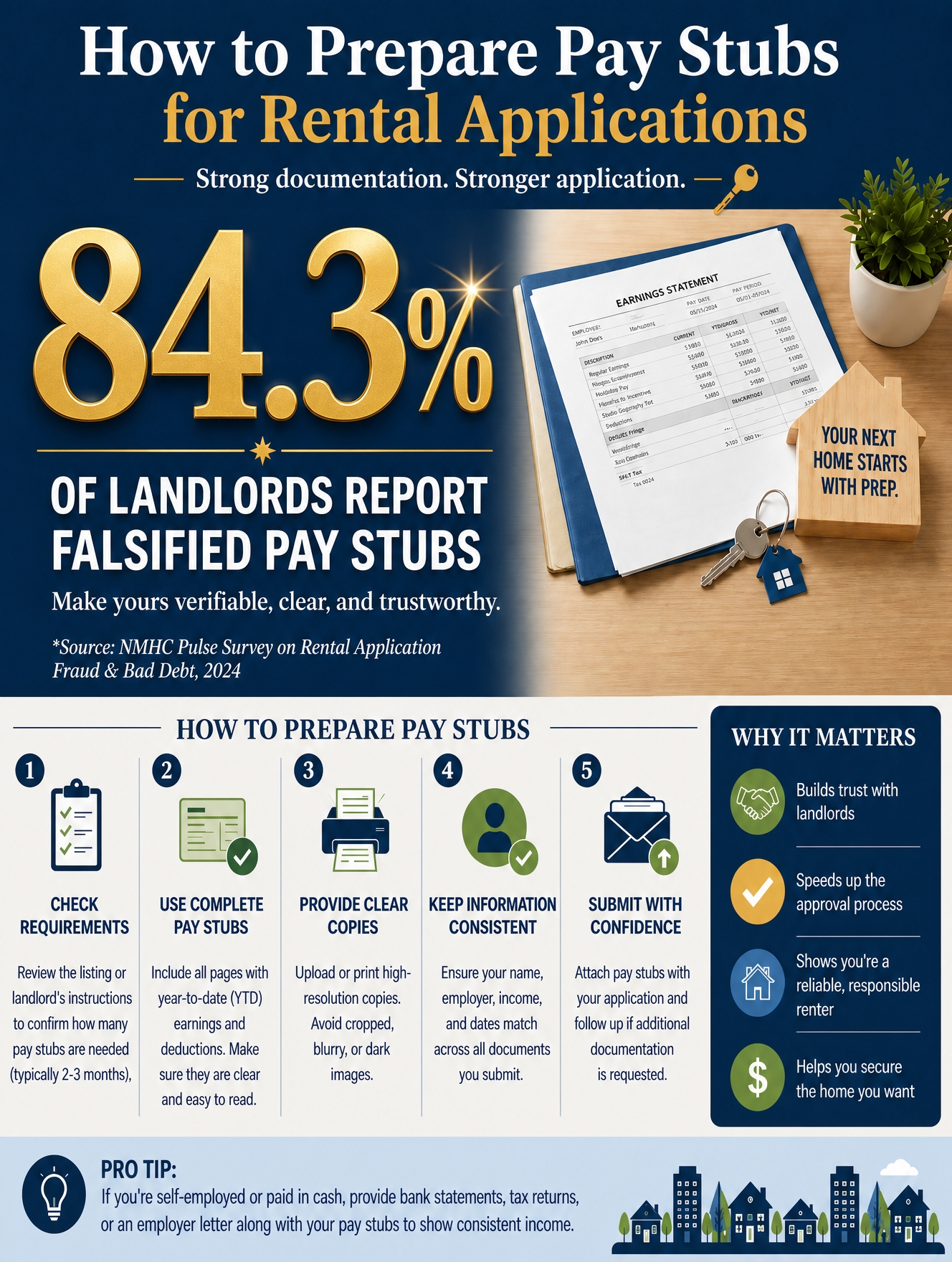
New job and you barely have any stubs
I had a client last month who got the apartment, but only because we prepped this early. They had one pay stub. Just one. The landlord wanted two. We didn’t argue. We added support.
What usually helps:
Provide an offer letter that includes start date, salary, and whether it’s full-time. Add a bank statement showing the first deposit (you can redact account numbers). And be upfront in a short note: “I started on X date, first pay hit on Y date, next pay date is Z.” Simple.
Variable pay that swings around
Commission and tipped income can look “unstable” even when it’s totally normal. Your job might be solid, but the stubs bounce. So show a longer window.
In our experience, 6 to 8 weeks of pay stubs calms people down. Sometimes a few months. Depends on the landlord. And it helps to point out a base salary separately from commission if your stub breaks that out.
One exception. If your variable pay is truly seasonal, like you’re a wedding photographer, a summer camp lead, or you do holiday retail, pay stubs alone may not carry the story. That’s when you pair them with prior-year income proof. Or an employment letter that explains seasonality.
If you want more context on how landlords evaluate the full application, our guide to rental housing applications for renters and landlords lays out what gets you approved and what quietly gets you skipped.
Redactions, privacy, and how not to look shady
You don’t need to hand over your entire identity. But you also can’t black out half the pay stub and expect trust. There’s a balance.
What you can usually redact
Most of the time, it’s reasonable to redact:
Social Security number (all but last 4). Bank account number (if shown). Any internal employee ID number. Sometimes your full address, depending on what’s on the stub and what you’ve already provided elsewhere.
Keep your name visible. Keep the employer name visible. Keep pay period dates visible. Keep gross pay, year-to-date totals, and net pay visible. Otherwise, the landlord can’t verify anything.
Avoid edits that trigger fraud alarms
Here’s where renters accidentally shoot themselves in the foot.
Don’t use a “beauty” app to blur text. Don’t use a sketchy PDF editor that leaves artifacts. And don’t change fonts or spacing. People who screen applications all day can spot that in two seconds. Even if they can’t explain it, they feel it.
We recommend using a standard redaction tool that cleanly blacks out the exact line. Not a fuzzy marker. Not a translucent blur. And save a copy for yourself before you redact, just in case someone asks you to re-send.
Also. Don’t over-redact deductions. Some landlords look at garnishments or child support and get nervous. That’s not great, but hiding it tends to backfire harder than explaining it.
Use pay stubs as a negotiation tool, not just a gatekeeper
This is the part people miss. Pay stubs aren’t only about getting approved. They can support your ask for better terms. Lower rent. Longer lease. Reduced fees. Even a faster approval.
When strong documentation helps you ask for a better deal
Landlords love low-friction tenants. The kind who pay on time and don’t create drama. Clean pay stubs signal that. So do consistent deposits and stable employment.
If your pay stubs show a clear cushion, you can sometimes use that to negotiate. Not by bragging. By positioning yourself as the safe choice.
Example I’ve used with clients: “We can move in quickly, we have steady income, and we’re easy to approve. If you can come down $75 a month, we’ll sign this week.” Not poetic. It works.
And if your budget is tight, you can still negotiate. Sometimes you negotiate structure instead of price. Like getting a longer lease at the same rate. Or asking them to waive a pet fee. Or shifting move-in dates to avoid paying double rent for a month. Our team at Rental Secrets focuses a lot on these market-based angles, because you’re not just pleading for a discount. You’re offering certainty.
How landlords can make this smoother too
We work with property managers as well, and honestly, a little clarity goes a long way. If you’re a landlord reading this, consider stating what you accept upfront. How many pay stubs? Whether you accept payroll portal exports. What to redact. How you handle variable income.
It reduces back-and-forth. It builds trust. And it tends to improve retention because applicants don’t start the relationship feeling suspicious or stressed.
FAQs for How to prepare pay stubs for rental applications
Can I use a screenshot from my payroll app instead of a PDF pay stub?
Usually yes, but it depends on the landlord. Screenshots get rejected when they’re cropped, missing the employer header, or don’t show pay period dates. If the app has an export or “download pay statement” option, use it. If you can’t, send full-page screenshots and combine them into one PDF so it feels official.
What if I’m paid in cash or I’m a contractor and don’t get pay stubs?
Then you’re basically building your own income proof packet. Most landlords will accept a mix of bank statements showing consistent deposits, invoices, a contract, or a letter from your client or employer. For contractors, recent 1099s can help too, but they’re backward-looking. Bank deposits are what tends to feel real-time.
Your next move
Put your pay stubs into one clean file. Make sure your name, employer, dates, and totals are readable. Redact lightly. Then send it like someone who’s done this before.
If you want to understand how the whole application gets judged, not just the pay stub piece, point yourself to our guide to rental housing applications for renters and landlords. That’s the playbook we use at Rental Secrets when we’re helping renters get approved and push for better terms.
Disclaimer: This article does not constitute legal advice.