

Landlords should ask for extra rental application info when they’ve got a real reason. Not because they’re curious. Not because “more data feels safer.” The line we use at Rental Secrets is simple: request only what you’d need to make a fair, defensible decision. And only when the application in front of you has a gap you can’t responsibly ignore.
And renters. You benefit from this too. Extra questions can be a red flag. Or they can be a normal “we just need to verify this one thing” moment that you can handle fast, keep your timeline, and avoid paying for extra holding costs, temporary housing, or a rushed move.
Ask for more info when something is missing, not when you feel nervous
Honestly? A lot of “additional info” requests happen because the landlord is anxious. The unit is expensive. The mortgage is high. Someone had one bad tenant in 2019 and they’re still emotionally recovering.
But anxiety isn’t a screening criterion. Missing or inconsistent details are.
Common missing pieces that justify a follow-up
When we work with renters on application strategy, the fastest wins usually come from spotting the missing puzzle piece before the landlord asks. Because once they ask, the clock starts. Another applicant has the chance to slide in. And just like that you’re suddenly competing.
Reasonable follow-ups include:
- Employment info that doesn’t match paystubs (dates, employer name, hours)
- Income listed without documentation, or documentation that’s unreadable
- No landlord references when the application asks for them
- Gaps in housing history that aren’t explained at all
- People who’ll live there not clearly listed (roommates, partner, kids)
Stuff that’s usually not okay to “just ask”
Here’s the thing. Some landlords drift into “tell me your whole life story” mode. That’s when renters should pause.
Most of the time, landlords shouldn’t be asking about medical details, immigration status, family planning, religious stuff, or anything that smells like protected-class screening. Even when they “don’t mean it like that.” Intent doesn’t erase impact. Or liability.
From the renter side, if the question feels personal in a way that isn’t tied to paying rent or taking care of the unit, it’s fair to ask, “Can you share what you need this for?” Simple. Calm. You’re not starting a fight.

Request more info when verification flags pop up
Verification flags are boring. Paperwork-y. That’s good. Boring is how you keep screening fair.
I had a client last month who swore their income was straightforward. It was. But their paystub showed a different company name than the application. Totally normal. Payroll processor. Parent company. Whatever. The landlord didn’t know that, got spooked, and was ready to move on. One quick clarification note fixed it.
What counts as a real flag
In our experience, these are the flags that actually matter:
Name mismatches. Married names, middle initials, preferred names. Fine. But landlords should confirm identity before running anything.
Income volatility. Commission, seasonal work, gig work. Not bad. Just needs context. A letter from the employer or recent deposit history can help.
Document weirdness. Cropped paystubs, missing dates, screenshots with no employer info. Sometimes it’s innocent. Sometimes it’s not.
How landlords can ask without making it weird
Real talk: tone matters. “Provide three months of bank statements” can feel like a demand. It can also feel invasive. Sometimes it’s appropriate, but you need to say why.
Better: “Your paystub doesn’t show year-to-date totals. Could you share either a YTD paystub or a recent bank deposit screenshot showing payroll deposits? Either one works.”
Short. Specific. Options. And suddenly the renter isn’t spiraling.
If you’re a renter trying to keep costs down, speed is your friend. Faster approvals mean fewer overlap days between leases, fewer storage fees, less “we had to extend the hotel again” chaos. That’s a big part of what we teach at Rental Secrets: remove friction before it becomes expensive.
Ask for extra details when the situation is nonstandard
Some applications aren’t “W-2 job, local landlord reference, done.” And that’s not suspicious. It’s modern life.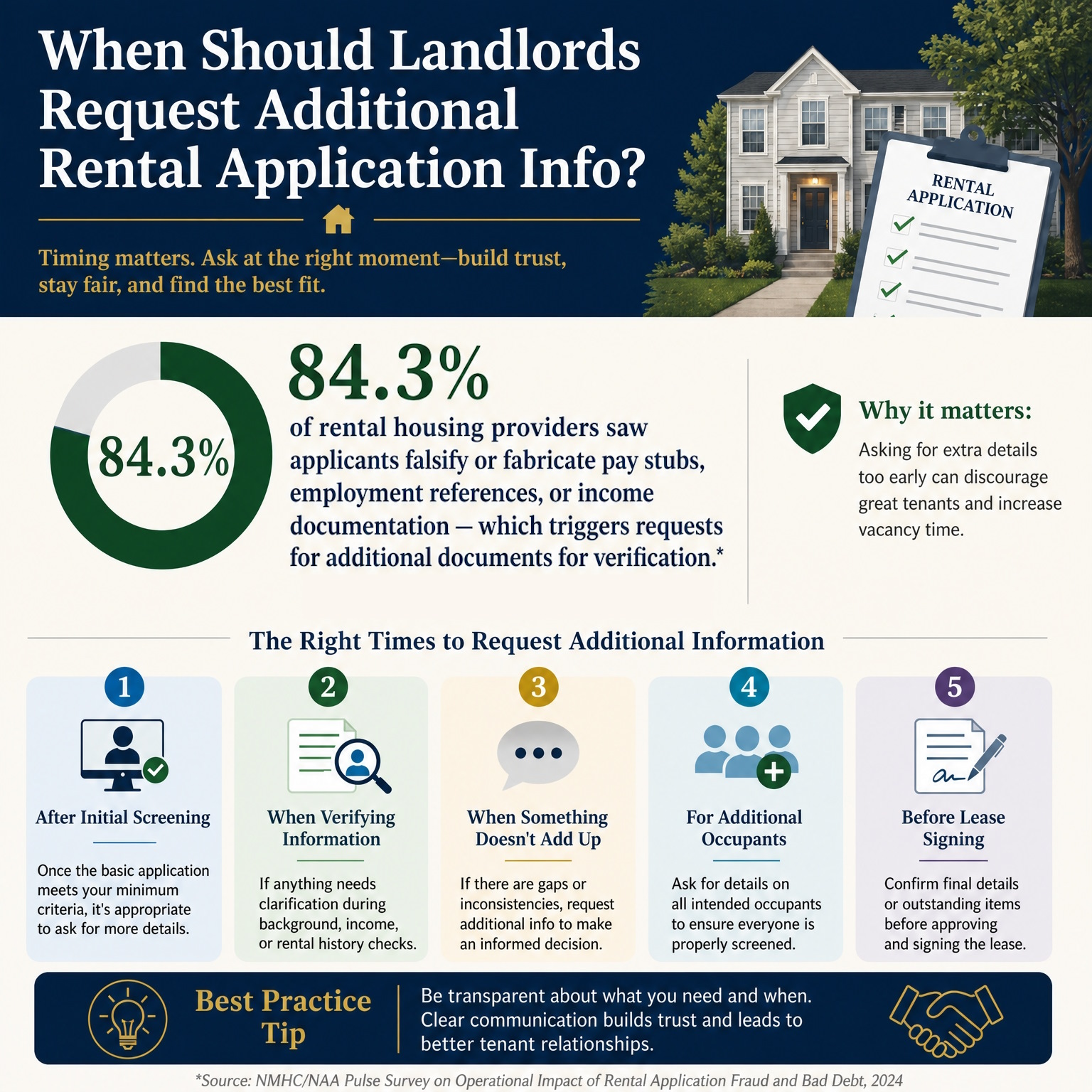
Students. New grads. Newly divorced. Families relocating. People building a business. People coming off a layoff. Normal. But different.
Students and first-time renters
Landlords often need more info because the normal proof isn’t there. No rental history. Limited credit. Income that’s seasonal.
Extra info that’s usually reasonable:
Co-signer details. Enrollment verification. Financial aid award letter. Internship offer letter. Sometimes a bigger deposit where allowed.
And renters, quick tip. Don’t wait to be asked. If you know you’re thin on “standard proof,” include a short note upfront. Two or three sentences. Clean. Confident. It changes the vibe.
Self-employed and gig workers
This bugs me because landlords sometimes overreact here. “Self-employed” isn’t code for “unreliable.” But income can be harder to verify. So yes, extra documentation can make sense.
Common asks: recent tax return, 1099s, a profit and loss statement, business bank statements, or contracts showing ongoing work. But landlords should pick one or two, not all of them. Otherwise it starts to look like they’re trying to scare you off.
If you’re negotiating rent, self-employed folks can sometimes do really well by pairing proof of savings with a shorter lease term or a slightly higher deposit (again, where legal). Market-based trade-offs. That’s straight out of what we cover in our renter playbooks.
Want the broader framework on how applications are evaluated? We keep an updated walkthrough in our guide to rental applications for renters and landlords. It’s the stuff landlords usually don’t say out loud.
Use additional requests to prevent discrimination and keep screening consistent
Counterintuitive, but true. Sometimes requesting more info is the fair move, because it standardizes your process across applicants.
But only if it’s consistent. The same gap gets the same follow-up. Every time.
Consistency is your legal and relationship shield
Landlords and property managers, you want retention? You want fewer angry move-out reviews? Your screening process is part of your brand, even if you never think of it that way.
We’ve seen owners create accidental drama by asking Applicant A for extra verification but not Applicant B. Even when it was innocent, it looks messy. People talk. Especially in student towns and tight housing markets.
A simple script helps: “We ask everyone for X when Y is missing.”
Renters can ask for that consistency too
If a landlord requests something that feels unusually deep, you can ask, “Is this standard for all applicants or is there something specific you’re trying to verify?”
Most reasonable landlords will answer. The ones who get defensive? That tells you something. Maybe you still take the place. Maybe you don’t. But at least you’re seeing the dynamic early.
If you want more on the communication side of this, we keep related landlord-renter scripts and timing tips over on our landlord communication and retention resources. That’s where we park the stuff that reduces back-and-forth and keeps everyone calmer.
FAQs for When should landlords request additional rental application info
Can a landlord ask for bank statements during the application?
Usually, yes. But “can” and “should” aren’t the same. Bank statements make the most sense when income is hard to document (self-employed, cash tips, new job without paystubs yet). A good process limits scope. For example, ask for proof of deposits, not a full deep dive into every transaction. If you’re a renter, you can redact irrelevant items while keeping your name, dates, and totals visible.
What should a renter do if the landlord keeps asking for more and more documents?
Pause and get clarity. Ask what exact requirement you haven’t met yet. Ask what document would satisfy it. One document, not five. If they can’t articulate the reason, you’re probably dealing with either disorganization or a soft denial. And that can cost you time and money. In tight markets, we tell renters to keep a “ready-to-send” packet and set a personal limit. At some point, it’s smarter to pursue the next option than to beg for an approval that’s drifting away.
The practical takeaway
Landlords should request additional application info only when it ties directly to verifying identity, income, rental history, or occupancy. Not as a fishing trip. Renters, your move is to anticipate the one weak spot in your application and patch it fast. That’s how you keep leverage. That’s how you keep costs down. And if you want help thinking like the person on the other side of the application, that’s basically what we do all day at Rental Secrets.
Disclaimer: This article does not constitute legal advice.